 Skip to content
Why You Keep Comparing Your Life to Everyone on Instagram
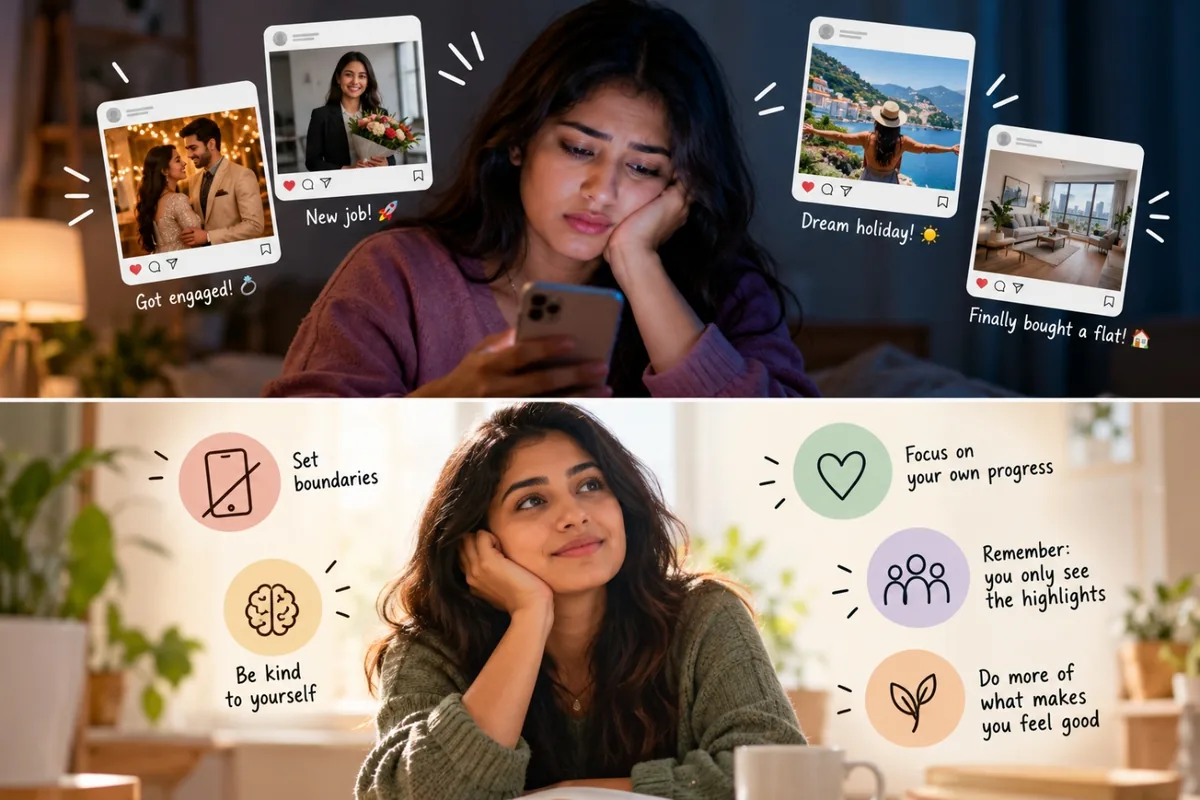
It is 11:40 at night. You open Instagram for “just two minutes.” A college friend has got engaged in Udaipur. A colleague has posted her promotion. Someone your age has bought a flat. You put the phone down, and your own day, which felt fine an hour ago, now feels small.
If this sounds familiar, you are far from alone. Comparing yourself to others on Instagram is one of the most common reasons people feel low after scrolling. It does not mean something is wrong with you. It is a normal mental habit meeting an app built around other people’s highlights.
In this blog, we look at why comparison happens, what it can do to your mood with online therapy for self-esteem, and practical ways to loosen its grip.
Why do we compare ourselves to others at all?
Psychologists call this habit social comparison: judging how you are doing by looking at the people around you. Psychologist Leon Festinger first described it in 1954. He suggested that when there is no clear yardstick for “good enough,” we use other people as one.
So asking “Am I doing okay?” by glancing at others is natural. Humans have always done it.
Comparison can go in two directions:
Upward comparison means comparing yourself with someone who seems better off.
Downward comparison means comparing yourself with someone who seems worse off.
Upward comparison is not always harmful. Seeing a friend run her first 10K can push you to start training. It starts to hurt when it stops being inspiration and turns into a verdict about your worth.
Why Instagram makes comparison feel so constant
Comparison existed long before phones. Instagram changes how often it happens, with whom, and with what kind of information.
You compare your whole life with their best moments
Posts are chosen, cropped and filtered. You see the wedding photos, not the family argument the night before. You see the holiday, not the EMI that paid for it. Meanwhile, you know every messy detail of your own life. It is your behind-the-scenes against their highlight reel.
The numbers are far bigger than they used to be
A generation ago, most people compared themselves with a few dozen relatives, classmates and neighbours. Today you can see hundreds of lives in ten minutes, including strangers and influencers who have teams, lighting and editing behind every post.
Passive scrolling feeds envy
How you use the app matters. In a 2015 study, people who browsed Facebook passively, meaning scrolling without posting, commenting or messaging, felt worse over time, and rising envy explained much of that drop. Active use did not show the same pattern. The study looked at Facebook, but passive scrolling is also how many people use Instagram.
Likes and followers turn life into a scoreboard
Likes, views and follower counts put a visible number on popularity. It becomes easy to treat those numbers as a measure of your value, even though they mostly reflect timing, algorithms and audience size.
How social comparison can affect your self-esteem
Research on social media and self-esteem points in a consistent direction. In a 2014 study, people who used Facebook most often had lower self-esteem overall, and this was partly explained by seeing more upward comparisons. In a second experiment, simply viewing a profile that looked more active and healthy than the participant’s own life lowered how good people felt about themselves in that moment.
That does not mean Instagram damages everyone. Social media can also offer connection, support and a sense of belonging, and people respond to it differently. But if comparison has become a habit, you may notice:
Feeling “behind” in life after scrolling
Brushing off your own achievements because someone else did more
Feeling pressure to spend money or time to keep up
Worrying about how your own posts will look or perform
Feeling unhappy with your body or appearance after seeing certain accounts
Feeling irritated or distant from friends whose posts sting
How to stop comparing yourself on Instagram
You do not need to quit the app or force yourself to never compare again. The aim is to change how often comparison happens and how much power it has over you.
1. Check in before and after you scroll
Before opening the app, ask yourself how you feel on a scale of 1 to 10. Ask again when you close it. Over a few days, you will see which times of day, and which accounts, leave you feeling worse.
2. Name what you are looking at
When a post stings, say to yourself: “This is a highlight, not a whole life.” The engagement post does not show the doubts. The promotion post does not show the late nights or the anxiety. You are seeing one selected moment.
3. Curate your feed
Mute or unfollow accounts that consistently leave you feeling worse. This is not a judgement of those people. It is a choice about what you let into your day. Follow accounts that teach you something, make you laugh or reflect your real interests.
4. Set a time boundary
Cutting back can help. In a 2018 experiment, university students who limited Facebook, Instagram and Snapchat to about 10 minutes each per day for three weeks reported larger drops in loneliness and depression than students who used the apps as usual. Both groups also reported less anxiety and fear of missing out, possibly because tracking their use made them more aware.
You do not need to hit an exact number. Try one change:
Use your phone’s app timer for Instagram.
Keep your phone out of reach for the last 30 minutes before sleep.
Avoid scrolling in the first half hour after you wake up.
5. Turn envy into information
Envy is uncomfortable, but it can point to something you value. Try this short exercise when a post bothers you:
What did I see?
What did I feel?
What does this tell me I want?
What is one small step towards it this week?
If a friend’s travel post stings, you may be missing adventure or rest. A weekend trip or a free Saturday might meet that need. If the answer is “I don’t actually want this,” you can let the feeling pass.
6. Compare with your past self
Your most useful comparison is you, a year ago. Write down three things that are better now: a skill, a habit, a relationship or how you handle a problem. Progress that is real and your own is easy to overlook while scrolling.
7. Use the app actively
Instead of silently scrolling, message a friend whose story you liked or reply to a post that made you think. Real interaction tends to feel very different from passive watching.
When to seek professional help
Comparison is common. Consider speaking to a mental health professional if:
You feel low, worthless or “not enough” most days
You want to scroll less but find you cannot stop
It is affecting your sleep, work, studies, eating or relationships
You feel ongoing distress about your body or appearance
You have started avoiding friends, events or posting altogether
A psychologist can help you understand what drives the comparison and work on the self-critical thoughts underneath it. Approaches such as cognitive behavioural therapy (CBT) can help you build self-esteem that depends less on how others seem to be doing.
If you ever have thoughts of harming yourself, please reach out right away. In India, you can call Tele-MANAS on 14416, a free government mental health helpline, or contact your nearest emergency service.
Conclusion
Comparing yourself to others is human. Instagram simply turns the volume up, putting hundreds of highlights in front of you before breakfast. Notice how the app makes you feel, curate what you see, set gentle limits and bring your attention back to your own progress.
If comparison has started to shape how you see yourself, you do not have to work through it alone. Zenup Health’s psychologists offer online therapy for self-esteem, overthinking and everyday stress, so you can talk things through at your own pace.
FAQs
Why do I compare myself to others on social media?
Comparing ourselves with others is a natural way humans judge how they are doing. Social media makes it more frequent because you see many edited, positive moments from a large number of people in a short time.
Is it normal to feel bad after scrolling Instagram?
Yes, many people do. Seeing others’ highlights can trigger upward comparison and envy, especially during passive scrolling. If the feeling is frequent or lasting, it may help to change how you use the app.
How do I stop comparing myself to others on Instagram?
Start by noticing how you feel before and after scrolling. Mute accounts that leave you feeling worse, set a time limit, and compare your progress with your own past rather than with other people’s posts.
Can Instagram affect your self-esteem?
It can. Research has linked frequent exposure to upward comparisons on social media with lower self-esteem. The effect varies from person to person and depends on how you use the app and whom you follow.
Should I delete Instagram to stop comparing?
Not necessarily. Many people feel better simply by cutting back, curating their feed and using the app more actively. A short break can still help if you feel stuck in the habit.
Can therapy help with low self-esteem and comparison?
Yes. Therapy for low self-esteem can help you understand the patterns behind constant comparison, challenge harsh self-judgements and build a sense of worth that depends less on others.
References
Festinger, L. (1954). A theory of social comparison processes. Human Relations, 7(2), 117–140. https://doi.org/10.1177/001872675400700202
Vogel, E. A., Rose, J. P., Roberts, L. R., & Eckles, K. (2014). Social comparison, social media, and self-esteem. Psychology of Popular Media Culture, 3(4), 206–222. https://doi.org/10.1037/ppm0000047
Verduyn, P., Lee, D. S., Park, J., Shablack, H., Orvell, A., Bayer, J., Ybarra, O., Jonides, J., & Kross, E. (2015). Passive Facebook usage undermines affective well-being: Experimental and longitudinal evidence. Journal of Experimental Psychology: General, 144(2), 480–488. https://pubmed.ncbi.nlm.nih.gov/25706656/
Hunt, M. G., Marx, R., Lipson, C., & Young, J. (2018). No more FOMO: Limiting social media decreases loneliness and depression. Journal of Social and Clinical Psychology, 37(10), 751–768. https://doi.org/10.1521/jscp.2018.37.10.751
Tele-MANAS, Ministry of Health and Family Welfare, Government of India. https://telemanas.mohfw.gov.in

