 Skip to content
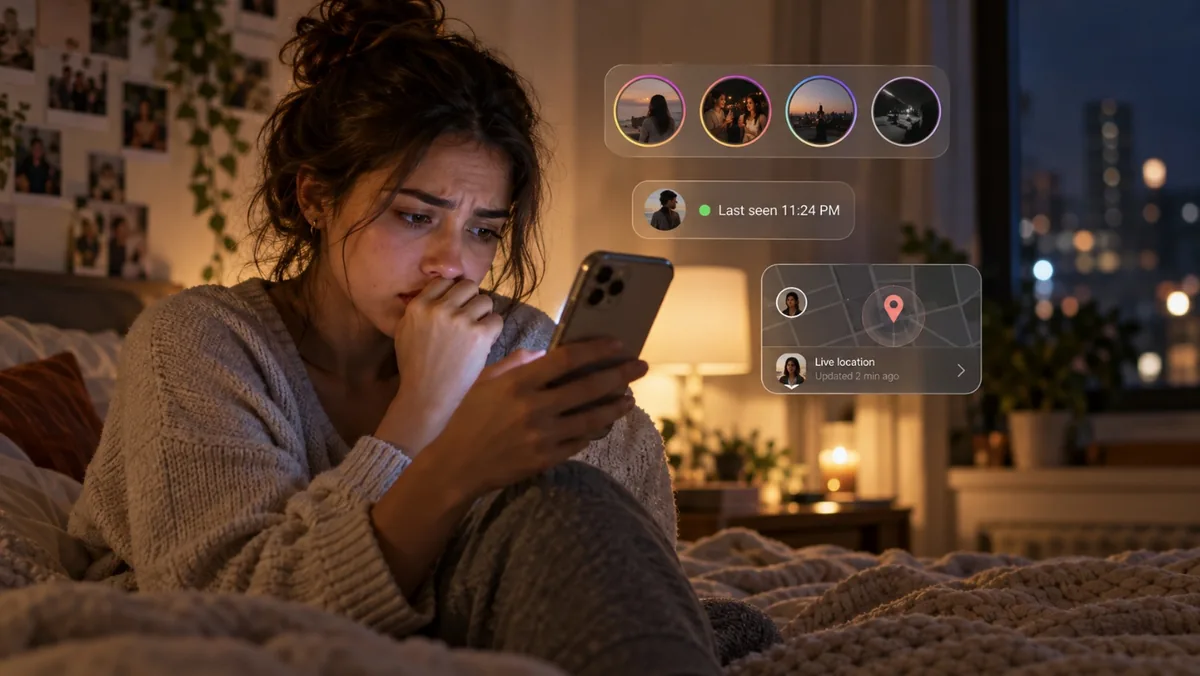
It’s 11:40 pm. You said goodnight an hour ago. You open WhatsApp anyway, just to see.
Online. And not typing to you.
Your stomach drops a little. You close the app. Three minutes later, you open it again.
If you keep checking their last seen, their stories or their live location, you have a very common habit. A Pew Research Center report found that about half of social media users in the US (53%) had used these platforms to check up on someone they used to date.
So the checking itself is ordinary. What matters is what it does for you, and what it costs you.
Why do you keep checking their last seen?
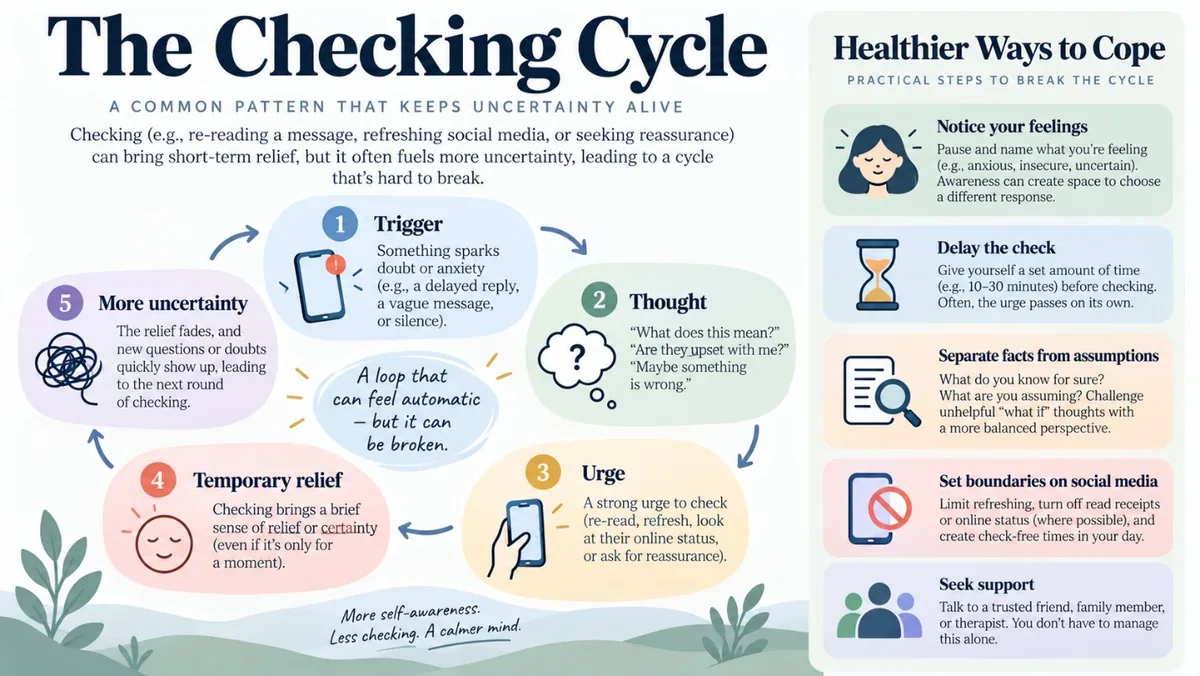
Because checking works, for about ten seconds.
When you don’t know where you stand with someone, your mind treats that gap as a problem to solve. Checking feels like collecting evidence. You see “last seen 10:52 pm” and, for a moment, the not-knowing gets smaller.
Then a new question arrives. Who were they talking to? Why were they online but not replying? The relief fades and the urge comes back, often stronger. Psychologists call this reassurance seeking: doing something to quiet a worry by getting a quick sign that things are okay. The Centre for Clinical Interventions explains that it brings relief in the short term and can keep anxiety going in the long term.
The app is built to be checked
Last seen, blue ticks, story viewers and location dots are small signals that update all day. Most of the time they tell you nothing. Once in a while, they show you something that feels important.
That unpredictability makes the habit hard to drop. Your brain learns that the next check might be the one that matters.
Unclear information invites the worst guess
A timestamp has no context. “Active 2 minutes ago” could mean they are replying to their boss, chatting with their mother or scrolling reels.
When you are already anxious, your mind fills the gap with the most painful explanation. Researchers who surveyed 308 university students described a feedback loop. Ambiguous information on a partner’s profile stirred up jealousy, jealousy led to more checking, and more checking turned up more ambiguous information.
Some people are more sensitive to distance
Your attachment style is the pattern you have learned for feeling safe with people you are close to. If closeness has felt unpredictable in the past, you may notice signs of distance quickly and take longer to feel reassured. Psychologists call this attachment anxiety.
A study in the journal Personal Relationships found that people higher in attachment anxiety checked their partner’s Facebook page more often. Day-to-day jealousy partly explained the link.
None of this is a flaw in your character. It is a learned pattern, and learned patterns can change.
Is it different when you keep checking an ex’s stories?
The urge is similar, but it can hurt more. After a breakup, checking can feel like the last thread connecting you to them.
In a study of 464 people, those who kept watching an ex-partner’s Facebook page reported more distress about the breakup, more longing and less personal growth. The study shows a link and cannot prove cause. It probably runs both ways: you check because you are hurting, and checking keeps the hurt fresh.
What does constant checking cost you?
| Area of life | What you may notice |
|---|---|
| Sleep | One last check at bedtime turns into forty minutes |
| Focus | You open the app mid-task without deciding to |
| Mood | Your day rises and falls with a timestamp |
| Trust | You collect proof instead of asking questions |
| The relationship | Conversations start to sound like cross-examinations |
| Self-respect | You feel embarrassed or secretive about how often you check |
If repeated thoughts are a big part of this for you, our earlier post on overthinking and daily life may help.
When does checking their location cross a line?
Sharing locations because you both agreed to, say for a late commute, is one thing. Tracking someone who doesn’t know, asking for passwords or expecting an explanation for every online minute is another.
The World Health Organization includes controlling behaviours among the forms of harm that can happen between partners. Most people who check a last seen are acting out of worry and have no wish to control anyone. But if your checking has grown into monitoring someone without their consent, treat that as a signal to pause and get support.
And if you are the one being monitored, and it leaves you feeling afraid or restricted, you deserve support too.
How can you stop checking their last seen, stories or location?
You don’t need to quit in a day. Aim to check less often, and to respond differently when the urge shows up.
1. Count before you cut
For two days, keep a simple tally. Each time you check, note the time and what you felt just before. Bored? Lonely? Ignored? Most people find the urge clusters around a few moments in the day.
2. Name the real question
The question behind the check is rarely “were they online?” It is usually closer to “do I still matter to them?” or “are we okay?” No app can answer that. Write the real question down so you can see it.
3. Delay by ten minutes
When the urge hits, set a timer for ten minutes and do something with your hands. Wash a cup, take the stairs, reply to a different message.
Urges tend to rise, peak and fade. If you still want to check when the timer ends, you can. Over a week or two, stretch the gap to twenty minutes.
4. Make checking harder
Mute their stories on Instagram. They are not notified.
Turn off your own last seen on WhatsApp. When yours is hidden, you can’t see theirs either.
Move the app off your home screen.
If you share locations, agree on when it stays on, or pause it for a while.
5. Ask the person, not the app
If you are in a relationship, one honest sentence does more than fifty checks. Try: “When replies go quiet in the evening, I start to worry. Can we talk about what works for both of us?”
It asks for something specific and blames no one.
6. Give the feeling somewhere to go
The anxiety under the habit still needs care. Call a friend, go for a walk, or write three lines about what you are afraid of. The aim is to look after the feeling without feeding the loop.
When should you seek professional help?
Consider speaking to a mental health professional if:
You have tried to cut down and can’t.
Checking takes up hours, or affects your sleep, work or studies.
Your mood depends heavily on what you find.
It causes repeated conflict, or you have started monitoring someone without their knowledge.
Worry, low mood or unwanted thoughts are showing up in other parts of your life.
You feel unsafe or controlled in your relationship.
A therapist can help you understand what the checking protects you from, and build other ways to handle uncertainty. Approaches such as cognitive behavioural therapy (CBT) work on the thoughts and actions that keep worry going. Couples can also work on trust and communication together.
If you ever feel unable to keep yourself safe, contact your local emergency services or go to the nearest hospital. In India, you can also call Tele-MANAS on 14416.
Conclusion
Checking is a way of trying to feel safe when you don’t know where you stand. It makes sense, and it rarely gives you what you are looking for. Start small: count, delay, ask.
If the pattern feels bigger than you can shift alone, Zenup Health’s psychologists offer online relationship counselling and therapy for overthinking, for individuals and couples. Reach out whenever you feel ready.
Frequently asked questions
Is it normal to check your partner’s last seen?
Yes, occasional checking is common. It becomes a concern when it is frequent, hard to stop, or starts to affect your mood, sleep or relationship.
Why do I keep checking my ex’s Instagram stories?
After a breakup, checking can feel like a way to stay connected. Research links watching an ex’s profile with more distress and longing, so muting or unfollowing for a while often helps.
Is checking someone’s last seen a sign of anxiety?
It can be linked to worry or relationship anxiety. Checking alone does not mean you have an anxiety disorder. Only a qualified mental health professional can assess that.
How do I stop checking someone’s last seen on WhatsApp?
Track how often you check, delay each urge by ten minutes, and hide your own last seen so theirs disappears too. Where you can, ask the person directly about what is worrying you.
Is it okay to track your partner’s location?
Location sharing can be practical when both people freely agree to it and either can switch it off. Tracking someone without their knowledge, or under pressure, breaches their privacy and damages trust.
Can therapy help with relationship anxiety and overthinking?
Yes. Therapy for overthinking and relationship counselling can help you understand what drives the urge to check and build steadier ways to handle uncertainty, alone or as a couple.
References
Pew Research Center (2020). Dating and Relationships in the Digital Age. Survey of US adults conducted in October 2019.
Centre for Clinical Interventions, Department of Health, Western Australia. Reducing Reassurance Seeking (information sheet).
Muise, A., Christofides, E., & Desmarais, S. (2009). More information than you ever wanted: Does Facebook bring out the green-eyed monster of jealousy? CyberPsychology & Behavior, 12(4).
Marshall, T. C., Bejanyan, K., Di Castro, G., & Lee, R. A. (2013). Attachment styles as predictors of Facebook-related jealousy and surveillance in romantic relationships. Personal Relationships, 20(1), 1–22.
Marshall, T. C. (2012). Facebook surveillance of former romantic partners: Associations with postbreakup recovery and personal growth. Cyberpsychology, Behavior, and Social Networking, 15(10), 521–526.
World Health Organization. Violence against women (fact sheet).
