 Skip to content
Everyone thinks about problems. Thinking helps you plan and make choices. It can become a concern when your thoughts become repetitive, difficult to control, or start affecting your daily life. You may replay a talk with someone. You may worry about what could go wrong. You may keep asking yourself if you made the right choice. This can take up time and leave you feeling tense or tired. Mental health experts often use the term repetitive negative thinking (RNT) for this type of thought pattern. RNT includes worry and rumination. It can occur with anxiety and depression. Overthinking itself is not a medical diagnosis. But it becomes a concern when it causes distress or affects your sleep or relationships.
Anxiety also remains common. The American Psychiatric Association’s 2026 annual mental health poll found that 48% of U.S. adults felt more anxious than a year ago, up from 43% in 2025. The poll surveyed 2,201 adults in May 2026. In this article, we will talk about why overthinking happens and when professional support may help.
What Does Overthinking Mean?
Overthinking is a common term. It describes a pattern of repeated thoughts that can be hard to switch off. Below are the two terms that help to explain it.
Rumination means thinking again and again about something that happened in the past. You may focus on a mistake, an argument, or something you wish you had done differently.
Worry focuses on the future. You may keep thinking about what could go wrong or how you will deal with a possible problem.
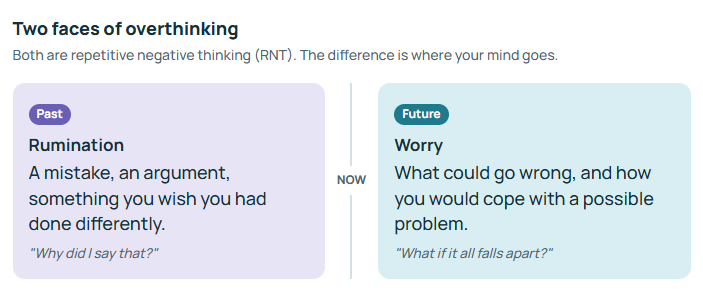
These thought patterns are normal at times. They become less useful when they keep going and do not lead to action. For example, thinking about how to fix a work problem can help. Thinking about the same problem for two hours without taking any step does not give you the same benefit.
The key question is simple: Is your thinking helping you solve the problem, or is it keeping you stuck? Research supports treatment for this pattern. A 2025 meta-analysis reviewed 55 studies with 4,970 participants, and it found that cognitive behavioural therapy (CBT) led to a moderate reduction in repetitive negative thinking compared with control conditions.
How Can Overthinking Affect Your Daily Life?
Repeated thoughts can affect more than your mood. They can change how you sleep, and make decisions.
Area of life | What you may notice |
Sleep | Your mind stays active when you try to sleep |
Focus | You keep returning to the same thought |
Decisions | Simple choices take too much time |
Work | You think about a task instead of starting it |
Studies | You spend too long checking or second-guessing your work |
Relationships | You replay talks or worry about what someone meant |
Mood | You feel tense, guilty, sad, or worn out |
Daily tasks | You put things off because you want more certainty |
These effects can form a cycle. For example, you may worry at night and sleep badly. Poor sleep can make it harder to focus the next day. You may then worry about your poor focus. This creates another round of worry.
This is why therapy for anxiety and overthinking should look beyond thoughts. It should also look at your habits, actions, and responses to stress.
Why Do You Overthink?
There is no single reason. Your thinking pattern may be linked to several factors. These can include:
- Fear of making mistakes
- Perfectionistic standards
- Fear of uncertainty
- Ongoing stress
- Relationship problems
- Work or study pressure
- Anxiety
- Low mood
- Trouble dealing with strong emotions
- Repeated need for reassurance
- Avoiding choices because you fear the outcome
Sometimes, thinking feels like a way to stay in control. You may think, “If I analyse this enough, I can prevent something bad from happening.”
But thinking cannot give you complete certainty. Some things will always remain unknown. Trying to remove all uncertainty can keep the thought cycle going.
What Can You Do When You Start Overthinking?
You do not need to force your mind to stop thinking. So, try changing what you do when the thoughts appear.
1. Name what is happening
First, notice the pattern. Ask yourself: “Am I solving a problem, or am I going over the same thought again?” This can help you separate useful thinking from repetitive thinking.
2. Separate facts from guesses
Take a piece of paper and write three things:
- What do I know?
- What am I assuming?
- What can I control?
This can help you see the difference between facts and predictions. For example, “They have not replied” is a fact. “They are angry with me” is an interpretation. The two are not the same.
3. Choose one small action
A real problem often needs action. Pick one step that you can take now.
You could:
- Send the email.
- Start the task.
- Ask one clear question.
- Make the appointment.
- Spend 20 minutes on the work.
You do not need to solve the whole problem at once.
4. Reduce repeated reassurance
You may ask someone the same question many times. You may check messages again and again. You may search online for another answer. These actions can make you feel better for a short time.
But repeated reassurance can keep the cycle going. Your mind may learn that you need outside confirmation before you can feel calm. Try waiting before you ask for reassurance again. Notice what happens to the feeling with time.
5. Give your mind a place to pause
Night can be a common time for repetitive thoughts. Keep a note beside your bed. Write down the concern and one action you can take the next day. Then return to your normal bedtime routine.
The aim is not to make your mind empty. The aim is to stop turning bedtime into problem-solving time.
When Should You Consider Therapy?
You may benefit from professional support when overthinking starts to affect your daily life. Look at the impact rather than the number of thoughts.
Consider getting help when:
- You often lose sleep because of your thoughts.
- You cannot focus on work or study.
- You take a very long time to make simple choices.
- You avoid tasks because you fear making mistakes.
- You feel tense or restless much of the time.
- Relationships are being affected.
- You cannot shift your attention from the same concern.
- You also have ongoing anxiety or low mood.
- The usual daily activities are becoming harder.
Therapy for overthinking can help you understand what starts the cycle. It can also help you change the actions that keep it going. You do not have to wait until the problem becomes severe.
What Happens During Therapy?
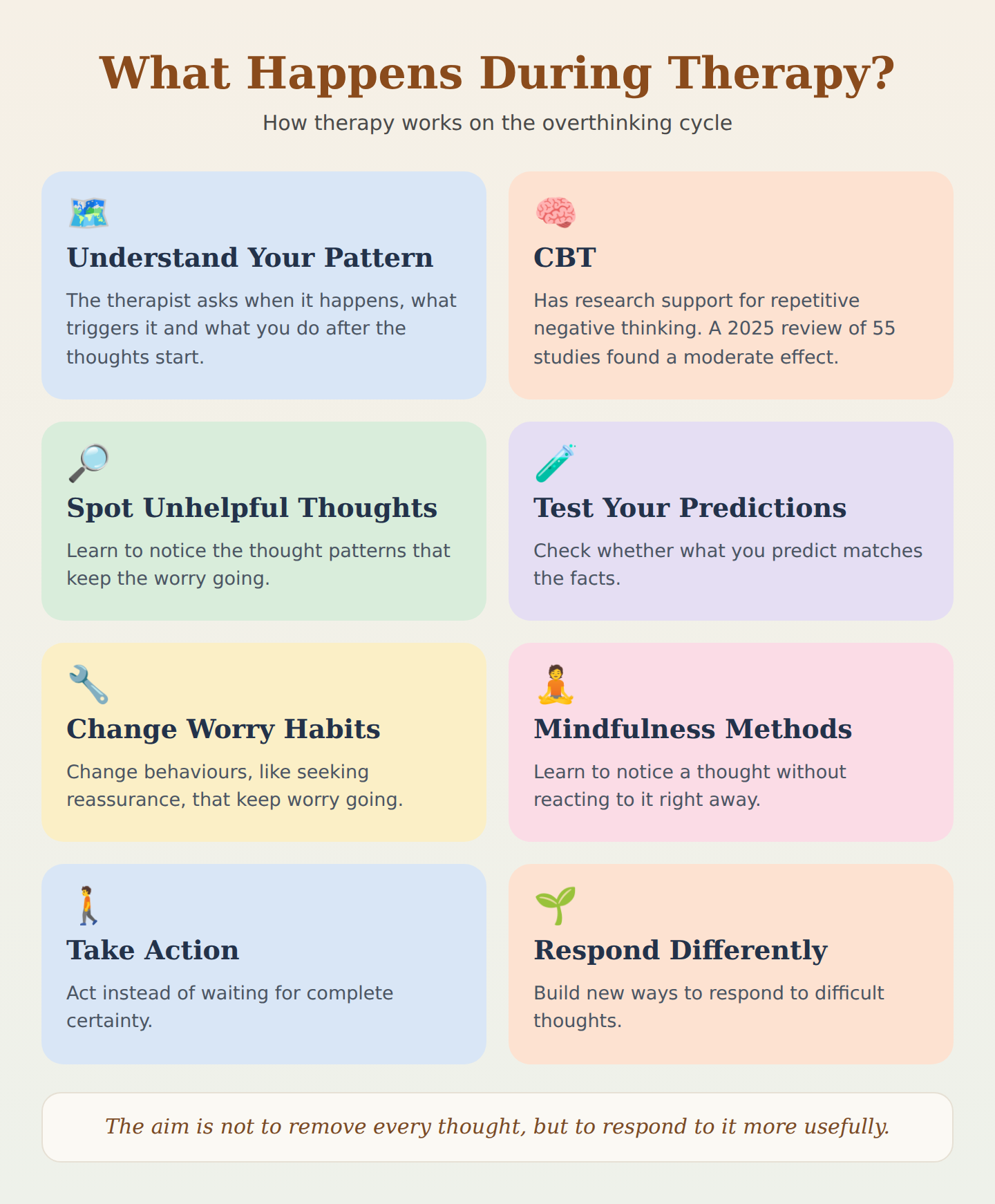
A therapist will first try to understand your pattern. They may ask:
- When does it happen?
- What tends to trigger it?
- What thoughts come up?
- What do you do after the thoughts start?
- How does it affect your daily life?
- Do you avoid certain situations?
- Do you often seek reassurance?
This helps the therapist understand the full pattern.
Cognitive behavioural therapy
CBT is a treatment approach that has research support for repetitive negative thinking. It can help you:
- Spot unhelpful thought patterns.
- Test whether your predictions match the facts.
- Change behaviours that keep worry going.
- Take action instead of waiting for complete certainty.
- Learn new ways to respond to difficult thoughts.
The 2025 meta-analysis found that CBT had a moderate effect on reducing repetitive negative thinking.
Mindfulness-based methods
A therapist may also use mindfulness-based methods. These can teach you to notice a thought without immediately reacting to it.
You may notice a worry without checking or trying to solve it right away. Zenup Health’s counselling service for overthinking describes work on thought patterns, rumination, decision-making difficulties, and mindfulness.
The aim of worry-related concerns is not to remove every thought from your mind. Thoughts are a normal part of mental life. The aim is to help you respond to thoughts in a more useful way.
When Should You Seek Medical Help?
Overthinking can happen without a mental health disorder. But, ongoing worry or rumination can also occur with conditions such as anxiety disorders and depression. That is why a proper assessment matters.
A mental health professional is able to assess all your symptoms in combination. Your thinking process can be assessed regarding its effect on your mood and functioning.
Contact a professional if your symptoms are severe enough or interfere with your ability to function. If you experience suicidal ideation, have trouble staying safe, or are in imminent danger, contact emergency services or go to the nearest emergency room.
Conclusion
The danger of overthinking occurs when the process starts to affect your everyday life. Firstly, try to observe the process. Make the difference between fact and prediction. Concentrate on things that you have control over and do one step instead of waiting for full confirmation. Remember about reassurance-seeking and sleeping habits too.
When these steps are not enough, professional support can help. Zenup Health provides online mental health services. This includes counseling for concerns such as overthinking, and stress.
You do not need to control every thought. The goal is to build a better response to thoughts that keep pulling you back into the same loop.
Frequently Asked Questions
Is overthinking a mental health disorder?
No. Overthinking is not a formal psychiatric diagnosis. It is a common term for repeated thinking that can become difficult to control. Worry and rumination can occur with anxiety, and other mental health conditions.
Can you stop overthinking completely?
You do not need to stop every thought. That would not be a realistic goal. Treatment can help you reduce repetitive thinking and change how you respond to it.
What is the best therapy for overthinking?
CBT has research support for repetitive negative thinking. The right approach depends on your symptoms and what keeps the pattern going. A therapist may also use behavioural methods or mindfulness-based techniques.
