 Skip to content
You know the feeling. You didn’t sleep well, and now everything feels like too much. Your group chat notifications feel like a personal attack. A tiny comment from a friend replays in your head for an hour straight. You cry at a dog food commercial, or snap at your roommate for leaving one dish in the sink. Nothing has actually changed since yesterday, except the sleep part.
That’s not you being dramatic. That’s your brain running on empty. There are different treatments and approaches, like therapy for sleep disorders, to fix this. Read more to find out!
Your Brain Is Working While You Sleep
Sleep isn’t just your body switching off for the night. While you’re out, your brain quietly sorts through everything that happened during the day, filing away what matters and resetting your emotional baseline for the next morning.
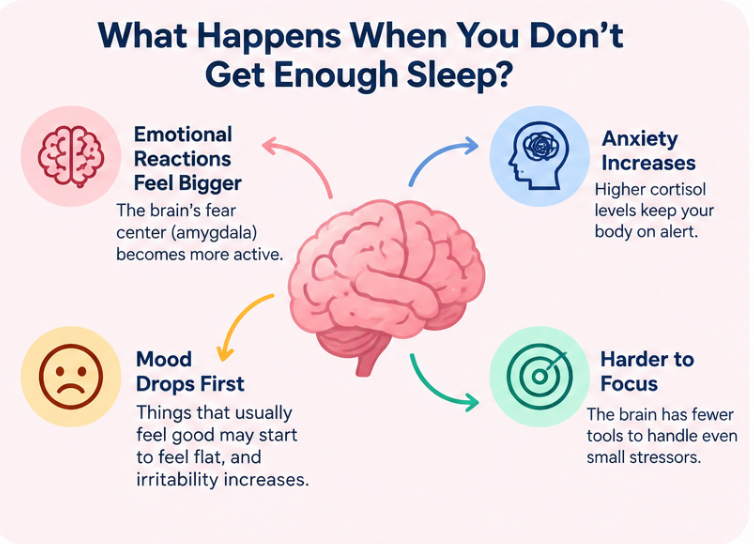
Skip that process, even for one night, and the reset doesn’t happen properly. The part of your brain that reacts to fear and stress, the amygdala, gets more trigger-happy. The part that’s supposed to keep it in check doesn’t have the bandwidth to do its job. So the small stuff starts to feel bigger, not because you’re overreacting, but because your brain genuinely has fewer tools to work with today.
The 3 am Spiral Isn’t Random
Anxious thoughts always feel louder at night, and that’s not a coincidence. Poor sleep raises cortisol, your body’s main stress hormone, and once it’s up, it doesn’t just switch off on its own. Your heart rate stays a little higher. Your body stays a little more on alert, even when nothing is actually wrong.
Here’s the annoying part: it works both ways. Anxiety keeps your mind racing at bedtime, which delays sleep and breaks it up once it starts. That lost sleep raises your stress levels even further, and the next night, falling asleep gets a little harder again. It’s a loop, and it doesn’t fix itself just because you want it to.
Your Mood Usually Dips Before the Anxiety Hits
Most people expect anxiety to show up first, but mood often goes first instead. Things that usually feel good- a favorite show, a text from a friend, your morning coffee- start to feel a little flat. Motivation gets harder to find. A few days in, irritability shows up too, and patience runs thinner than usual.
A lot of people never connect this back to sleep. They just assume something is wrong with them.
When It’s More Than Just a Rough Week
Everyone has an off night now and then. If this has been going on for weeks, though- if you’re tired all the time no matter how long you’re in bed, or someone’s mentioned you snore or gasp in your sleep, that’s worth paying attention to. It could be something like sleep apnea, which quietly disrupts sleep without fully waking you up, and it’s closely tied to both anxiety and low mood. You can always try therapy for sleep disorders and work on your routine.
Why “Fix Your Sleep Hygiene” Doesn’t Always Work
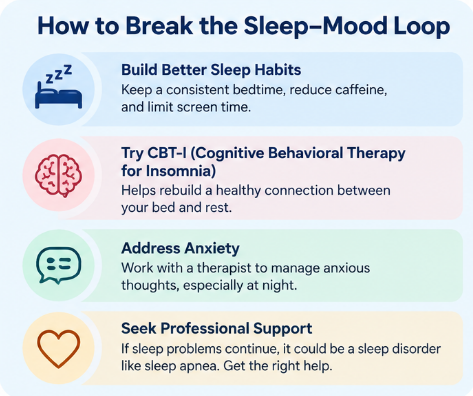
You’ve probably already tried the usual advice: less caffeine, phone away, a consistent bedtime. Those habits genuinely help, and they’re worth keeping. But when your mind won’t stop racing the moment your head hits the pillow, no amount of blackout curtains will fix that. When anxiety or an actual sleep disorder is driving the problem, surface-level habit tweaks can only take you so far.
What Actually Helps
This is where something like CBT-I, or cognitive behavioral therapy for insomnia, comes in. It’s one of the most effective tools available, and it works by rebuilding the connection between your bed and rest instead of your bed and stress or scrolling. A therapist can help you work through the anxious thoughts that show up at night while addressing what’s happening with your sleep directly, since the two usually feed each other rather than existing on their own.
The Point Isn’t Just “Sleep More”
It’s breaking the loop between sleep and mood. Better sleep supports a steadier mood, and a steadier mood makes it easier to sleep in return. You don’t have to figure out which one to fix first on your own.
If this sounds familiar, Zenup Health can help you figure out what’s actually going on and build a plan around your specific pattern, not a generic checklist.
