 Skip to content
Why Do I Overthink Every Conversation After It Ends?
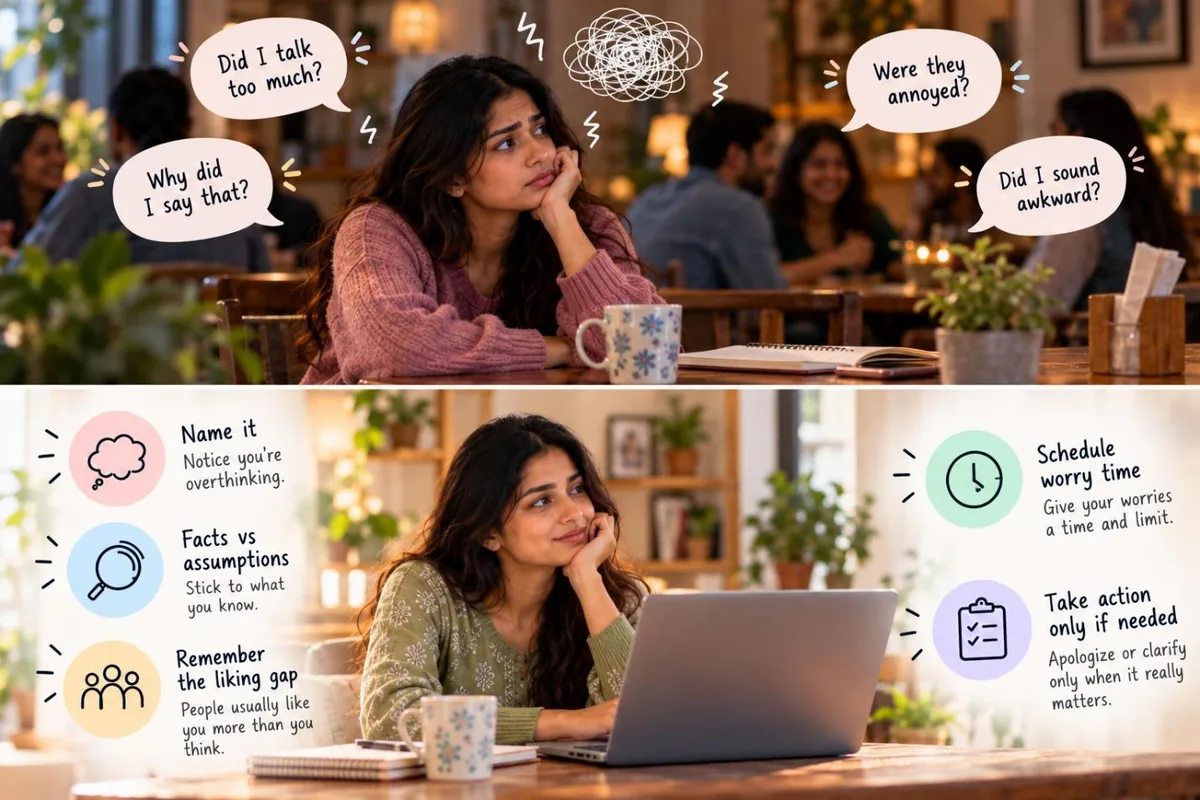
You had a great dinner with your new colleagues. Laughter, great food and you said goodbye smiling. But as soon as you’re on the auto home, you start to overthink. ‘Why did I say that?’, ‘Did they look annoyed when I cut them off?’ ‘I talked about me too much!’.
You’re wide awake at 1 am, changing the sentences you should’ve said. You check on WhatsApp if anybody has messaged.
If you overthink conversations, you’re in good company! It’s one of the most common things people report to psychologists. We’ll look at why your brain does this, how you can move on and when therapy for overthinking can help.
What does overthinking look like?
You may:
- Go over specific parts of a conversation
- Read into people’s tones, pauses and expressions
- Imagine what they thought of you
- Come up with better responses
- Check messages, seen ticks and reactions
- Apologise for something nobody else noticed
Most people will overthink occasionally, particularly after a significant meeting or a first date. It only becomes an issue if you overthink nearly every conversation and it takes away from your evening, sleep, or confidence.
Why does your brain do this?
1. Your brain values fitting in
We are all social beings and in our history fitting in with the group was essential for survival. Your brain still likes to check for any signs of rejection, so a conversation going wrong can feel like a small danger.
2. It feels like problem solving
This type of repetitive thinking is known as rumination. It’s when we passively think the same thing over and over again about our distress, causes and consequences (Nolen-Hoeksema, Susan et al.). It gives you a sense of being productive but rarely does anything and actually makes you feel negative for longer.
3. You notice your blunders more
Research around the spotlight effect has shown people overestimate how much people notice their mistakes and how they look. Your blunder probably went unnoticed!
Plus there is the liking gap. In a series of studies in 2018 people had a chat with a stranger and then were asked to guess how much their partner liked them. They consistently guessed lower than they actually did. This is because people get too caught up in their own worries about what they’ve said and don’t notice their partners positive signs. In one study with college room mates the liking gap lasted months!
4. Fear of negative evaluation
If you had a lot of criticism growing up or learnt that keeping people happy kept you safe, you may be extra sensitive to any signs of disapproval. Fear of negative evaluation is a key part of social anxiety.
5. Too many assumptions
Texts lack tones, expressions and immediate feedback. This can cause you to assume the other person meant something by a short response, long pause or leaving you on seen. Usually your anxious brain will assume the worst.
6. Tiredness
Overthinking often increases at night when you’re tired.
How to reduce overthinking after conversations
1. Name it
As soon as you start to overthink tell yourself ‘I’m overthinking’. By naming the pattern you create a slight distance between you and the thought, making it feel less true.
2. Are you doing anything?
Ask yourself one question ‘Am I doing anything?’. If you really did upset someone or leave them confused, take action. Send them a short and simple message like ‘Hope I didn’t cut you off earlier, I’d love to hear the rest of your story!’. Otherwise if you aren’t doing anything the overthinking isn’t helping.
3. Fact vs assumption
Create two columns. List the facts in one column e.g. ‘They responded with one word’. Then in the other column list your assumptions e.g. ‘They are annoyed with me’. Then ask yourself ‘What else could it mean?’. Maybe they were busy, tired or just not a big texter.
4. Remember the liking gap
If you’re convinced they didn’t like you, remind yourself people often don’t realise how much people like them. Your biggest critic in the conversation was probably you.
5. Schedule overthinking time
Give yourself 15-30 minutes in the early evening to overthink. If you catch yourself overthinking at another time, write it down and tell yourself ‘I’ll come back to this’. A review of seven trials with nearly 1000 participants in 2024 showed this technique (worry postponement) reduced the frequency and duration of worrying.
6. Talk to yourself as a friend
Try talking to yourself using your name. ‘Riya you were fine! Everyone was chatting and laughing’. Research has shown that people who reflect on a stressful speech using their name or you instead of I ruminate less. It helps to take a step back and see the situation clearly.
7. Distraction
Telling yourself to stop thinking rarely works. Find a distraction, go for a walk, give a friend a call, cook, play a game or listen to music.
8. Avoid overthinking at bedtime
If you overthink more at bed time, keep your phone away from your bed.
Signs it may be an issue
- If you spend hours overthinking most days
- Losing sleep regularly
- Avoiding social events, calls or meetings
- Often needing reassurance you didn’t upset anyone
- Feeling drained or low after normal interactions
You may want to seek support.
When to seek professional help
If any of this sounds familiar or overthinking is affecting your work, relationships or mood, speaking to a psychologist may help. Overthinking after conversations can sometimes be linked to social anxiety or generalised anxiety. A professional can help you understand what is happening.
Therapies often used to help overthinking include cognitive behaviour therapy (CBT). This helps you recognise unhelpful thought patterns, challenge them and practice new responses. Online therapy for anxiety can help you begin from a place where you feel comfortable.
If you’re also getting stuck on specific conversations, our blog Why Do I Replay Conversations in My Head may help.
If you ever feel overwhelmed or have any self-harm thoughts please reach out. In India you can call Tele-MANAS (14416) free government mental health line. Or call 112 in an emergency.
Conclusion
Overthinking conversations is your brain trying to help your relationships but ultimately leaves you feeling drained. Most people won’t even remember what you said and likely like you more than you think. By adding a few simple habits you can stop overthinking and allow conversations to finish.
If overthinking is starting to take up too much of your day, our psychologists at Zenup Health offer confidential online therapy sessions to help you reduce overthinking and feel more comfortable around people.
FAQs
Why do I overthink every conversation?
Your brain is wired to look out for signs of rejection. You may also be overthinking slightly awkward moments. Stress, tiredness, fear of judgement and a tendency to ruminate can cause you to overthink more.
Is overthinking conversations a sign of anxiety?
It can be but isn’t always. Most people overthink some conversations. If you’re overthinking most conversations, it’s causing you real distress or you’re avoiding people it may be linked to social anxiety. Speaking to a professional can help.
How do I stop overthinking after conversations?
Name the pattern, ask yourself if you’re doing anything, fact vs assumption and schedule a short overthinking time. Find a distraction.
Why do I always feel like I said the wrong thing?
People often notice their awkward moments more and don’t realise how much people like them. This is often your inner critic.
Can therapy help?
Yes! Therapies often used to help with overthinking include CBT. This helps you recognise thinking patterns, challenge them and respond differently. It will vary how quickly it helps.
Why do I overthink more at night?
There are less distractions and you’re tired so it can be harder to take a step back. Creating an unwind routine and keeping your phone away from your bed can help.
