 Skip to content
How to Access Online Therapy in India When You Live With Your Family
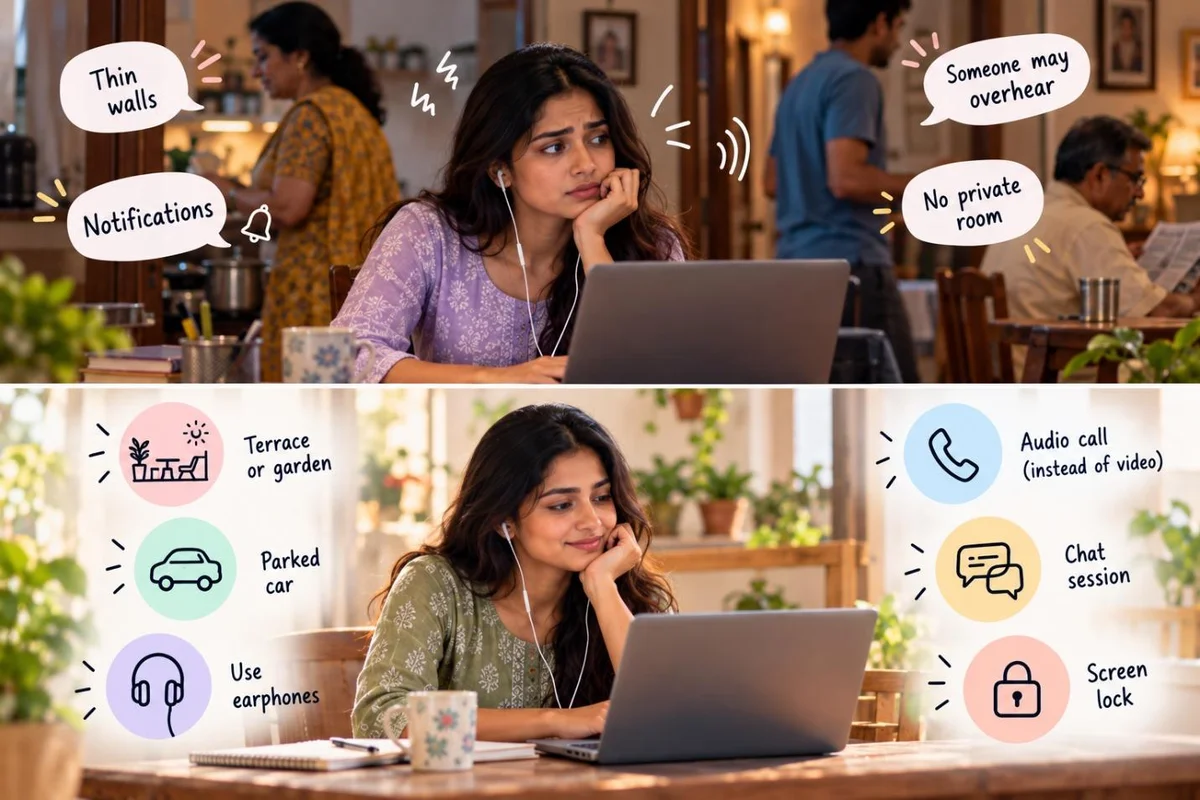
Rohan has wanted to start therapy for months. He’s found a psychologist and even picked a time slot. There’s just one problem: he lives in a 2BHK in Thane with his parents, his grandmother and his younger sister. The walls are thin, someone is always in the hall, and his mother has a habit of walking in to ask if he’s eaten.
Where is he supposed to talk about how he really feels?
If you’re looking for online therapy in India but live with family, privacy can feel like the biggest hurdle. The good news: with a little planning, it’s very possible. In this blog, we cover whether online therapy works, how to find private space, which format to choose and how to protect your privacy before, during and after sessions.
Why privacy at home feels so hard
In many Indian homes, personal space is limited. Rooms are shared, joint families are common, and doors stay open. On top of that, you might worry that:
Someone will overhear you talking about family issues
Parents won’t understand why you need therapy
Someone might see a notification, payment message or email
You won’t be able to speak openly if you feel watched
These worries are valid, and they’re one of the most common reasons people delay therapy. But they don’t have to stop you.
Does online therapy actually work?
Yes, for many people and many concerns. A 2021 meta-analysis of dozens of studies found that psychotherapy delivered over live video produced large improvements. Its results were broadly similar to in-person therapy, with especially strong effects for anxiety, depression and post-traumatic stress, and for cognitive behavioural therapy (CBT).
In India, the government’s Telemedicine Practice Guidelines (2020) allow registered doctors, including psychiatrists, to consult patients remotely by video, phone or chat. Online mental health care is now a recognised, mainstream option.
Is online therapy confidential?
Mental health professionals are bound by confidentiality. What you share in sessions stays between you and your therapist, except in rare situations involving serious risk to you or someone else. Your therapist will explain these limits at the start.
The part you control is your own environment: where you sit, what’s on your screen and who can see your phone. The next section covers exactly that.
How to find a private space
You don’t need a perfect room. You need a spot where you can speak without being overheard for 45 to 50 minutes. Some options:
A parked car. One of the most popular therapy spots for a reason.
The terrace, building garden or a quiet stairwell, at a time when few people are around.
A walk with earphones, if you choose an audio session.
A friend’s place, if you have a friend who’ll lend you a room for an hour.
When the house is empty, such as early mornings, when family is out, or during their regular routines like evening walks or temple visits.
Your room with sound cover. Close the door, switch on the fan or play soft music outside the door, use earphones with a mic and speak softly. Sit facing the door so you can see if someone comes in.
Choose a format that fits your situation
| Format | Works well when | Privacy at home |
|---|---|---|
| Video | You have a private room or car and want face-to-face connection | Lowest: others can hear you and may see your screen |
| Audio call | You can step out for a walk or sit on the terrace | Medium: easier to take outside |
| Chat or text | You can’t speak freely at all, or find writing easier | Highest: silent, but check that no one can see your screen |
You can also mix formats, such as video when the house is empty and chat on busier days. Ask your therapist which formats they offer.
Protect your digital privacy
Use your own phone or laptop, with a screen lock
Turn off notification previews for your therapy app, email and messages
Use an app lock if your family sometimes borrows your phone
Keep calendar entries neutral, such as “call” or “appointment”
Remember that UPI and bank SMS alerts can show who you paid, so think about which account or method you use
If you share a computer, log out and clear your browser history after sessions
What to tell your family, if anything
You don’t owe anyone details about your therapy. If you need to explain a closed door, “I have a private call” or “I have an online appointment” is true and enough.
Some people eventually choose to tell their family, and find it helps. If you’d like to, our blog “How to Talk to Your Parents About Wanting to See a Psychiatrist” has scripts that work for therapy too.
Make the most of each session
Tell your therapist about your privacy limits at the start. They’re used to this and can adapt.
Agree on a plan for interruptions, such as a code word, a quick switch to chat, or rescheduling the rest of the session.
Keep a small notebook to jot down thoughts between sessions, and keep it somewhere private.
Give yourself five minutes afterwards before walking back into family life, so you can settle.
If home doesn’t feel safe
Sometimes privacy is about more than awkwardness. If someone at home controls your phone, monitors your conversations, threatens you or hurts you, please tell your therapist. They can help you think through your safety and next steps. If you are in immediate danger, call 112.
When to seek help urgently
If you’re having thoughts of ending your life or harming yourself, don’t wait for the perfect private moment. Call Tele-MANAS on 14416, a free government mental health helpline, or 112 in an emergency, and tell someone you trust.
If you’re under 18, a parent or guardian usually needs to be involved in ongoing treatment. A school counsellor or Tele-MANAS can support you in the meantime.
Conclusion
Living with family doesn’t have to keep you from getting support. A parked car, a quiet terrace, a chat session or an early-morning call can all become your therapy space. Tell your therapist about your situation, protect your phone, and start where you are.
Zenup Health offers confidential online therapy sessions with experienced psychologists, so you can get support from wherever you find your quiet corner. Let your therapist know about your privacy needs when you book, and they’ll work with you around them.
FAQs
Can I do online therapy in India if I live with my parents?
Yes. Many people do. Find a private spot such as a parked car, a terrace or your room with sound cover, or choose an audio or chat session if you can’t speak freely. Tell your therapist about your situation so they can adapt.
Is online therapy confidential in India?
Mental health professionals are bound by confidentiality, except in rare situations involving serious risk. You can protect your side by using your own device, turning off notification previews and keeping calendar entries neutral.
Is online therapy as effective as in-person therapy?
Research suggests video therapy works about as well as in-person therapy for many concerns, including anxiety and depression. The best format is the one you can attend consistently and speak freely in.
Can I do therapy without my parents knowing?
If you’re 18 or older, yes. You can book online therapy sessions yourself and keep them private. If you’re under 18, a parent or guardian usually needs to be involved, but a school counsellor or Tele-MANAS (14416) can help meanwhile.
Is chat therapy as good as video?
Chat can be a helpful option when privacy is limited or writing feels easier. Some people prefer video for a stronger connection. Your therapist can help you choose, and you can switch between formats.
How do I find a therapist near me online?
With online therapy, location matters less. Look for a qualified psychologist or psychiatrist on a trusted platform, check their credentials, and choose someone who offers formats that fit your home situation.
References
Fernandez, E., Woldgabreal, Y., Day, A., Pham, T., Gleich, B., & Aboujaoude, E. (2021). Live psychotherapy by video versus in-person: A meta-analysis of efficacy and its relationship to types and targets of treatment. Clinical Psychology & Psychotherapy, 28(6), 1535–1549. https://doi.org/10.1002/cpp.2594
Ministry of Health and Family Welfare, Government of India, & NITI Aayog. (2020, March 25). Telemedicine Practice Guidelines. https://covid19dashboard.mohfw.gov.in/pdf/Telemedicine.pdf
Ministry of Health and Family Welfare, Government of India. Tele-MANAS. https://telemanas.mohfw.gov.in
