 Skip to content
Why Do I Keep Replaying Conversations in My Head?
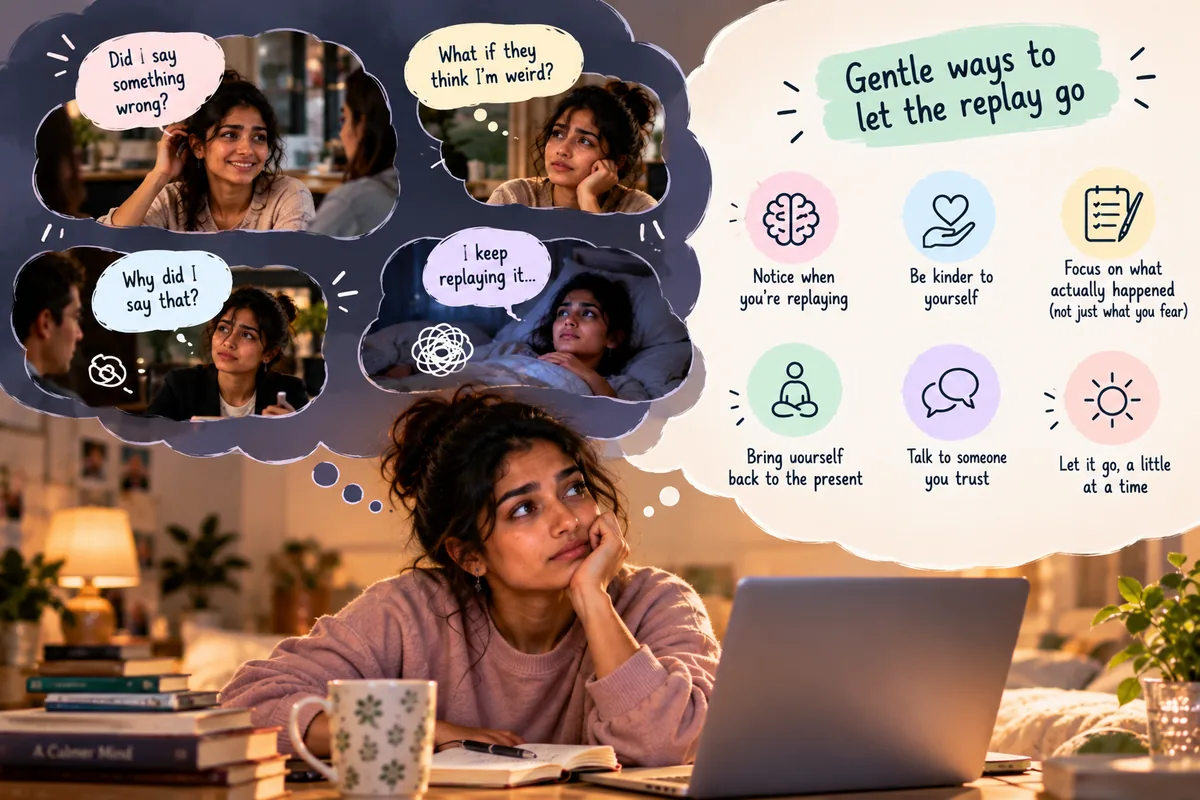
It is 11:40 at night. The lights are off, your phone is face down, and your brain chooses this moment to replay something from lunch. A colleague said, “Have a good weekend,” and you replied, “You too, happy birthday!” It was not their birthday.
Nobody at the table seemed to mind. Yet here you are, hours later, watching the clip again. Then again. You start wondering whether they think you are odd, whether you talk too much, whether that other comment in last week’s meeting sounded rude.
If you often find yourself replaying conversations in your head, you are far from alone. This pattern is common, it has a name in psychology, and there is good research on why it happens and what helps. If these loops keep coming back, therapy for overthinking can also help you break the habit.
What is post-event processing?
Psychologists call this habit post-event processing. Put simply, it means going back over a social situation after it has ended, usually focusing on what you think went wrong.
The idea comes from a well-known model of social anxiety developed by psychologists David Clark and Adrian Wells in 1995. They noticed that many socially anxious people hold a detailed “post-mortem” after an interaction. The review is rarely neutral. It tends to dwell on awkward moments, imagined judgement and how anxious you felt.
A 2008 review by Brozovich and Heimberg pulled together the research on this. It showed that post-event processing is closely tied to social anxiety, that it tends to dwell on negative details and on how a person thinks they looked, and that it can feed worry about the next social situation.
You do not need to have social anxiety to do this. Most people replay a conversation now and then, especially after a job interview, a first meeting with in-laws or a tense call with a manager. It becomes a problem when the replays are frequent, harsh and hard to switch off.
Why your brain keeps hitting replay
It is trying to protect you
Being accepted by others matters deeply to us, so the brain watches closely for any sign that we embarrassed ourselves or upset someone.
Replaying a conversation can feel like problem-solving: “If I go over it once more, I will understand what went wrong and never do it again.” The trouble is that the replay rarely produces a new answer. It mostly produces more worry.
The replay is not a recording
A replay is not an accurate video. It is an edited version, shaped by how you felt in the moment.
Clark and Wells described how anxious people often picture themselves from the outside, as if they were watching themselves through someone else’s eyes. That inner picture is usually based on how nervous they felt, not on how they actually came across. So if your face felt hot, the replay shows you as bright red and visibly flustered, even if no one noticed.
The spotlight effect
In a well-known set of studies, psychologists Thomas Gilovich, Victoria Medvec and Kenneth Savitsky asked university students to walk into a room wearing a T-shirt they found embarrassing. The students expected many people to notice. In reality, far fewer did, roughly half as many as they had predicted.
The researchers called this the spotlight effect: we tend to believe others notice our appearance and actions much more than they really do. Your “happy birthday” slip feels huge to you because you lived it from the inside. To your colleague, it was probably a two-second blip in a busy day.
The liking gap
There is another reassuring finding. In 2018, Erica Boothby and colleagues studied people after conversations, including strangers meeting in a lab and first-year university students getting to know their roommates. Again and again, people underestimated how much their conversation partner liked them and enjoyed talking to them.
The researchers named this the liking gap. In their words, people are often “liked more than they know.” So while your mind replays the awkward pause, the other person may be remembering a pleasant chat.
How replaying conversations shows up in everyday life
Post-event processing can look different for different people. You might notice:
Going over a meeting, a family function or a WhatsApp voice note long after it is done
Rehearsing what you should have said, sometimes for days
Rereading sent messages to check whether they sounded rude or “too much”
Feeling a wave of embarrassment when a memory pops up while you are brushing your teeth or sitting in traffic
Avoiding the person afterwards, or over-apologising for something they did not notice
If general overthinking about the future is also part of your day, our blog Is Overthinking Affecting Your Daily Life? Here’s What You Can Do covers that side in more detail.
How to stop replaying conversations: five things to try
These small steps will not make the replays vanish overnight, but practised regularly, they can loosen the habit.
1. Name it when it starts
When the replay starts, label it quietly: “This is post-event processing.” Naming a thought pattern creates a little space between you and it.
2. Step back with self-distancing
Psychologists Ethan Kross and Ozlem Ayduk have studied a technique called self-distancing, which means looking at a situation as an outside observer instead of reliving it through your own eyes.
Two simple ways to do this:
The fly on the wall: Picture the conversation as if you were watching it from a corner of the room. What would a neutral observer actually see?
Use your own name: Instead of asking “Why did I say that?”, ask “Why did Priya say that?” In one series of studies, people who reflected on a stressful speaking task using their own name or “you” instead of “I” reported less distress and ruminated less afterwards.
The aim is the calm, kind perspective you would easily give a friend.
3. Check the evidence, not the feeling
Ask yourself a few direct questions:
What did the other person actually say or do afterwards?
Did anyone react in a way that clearly showed offence?
If a friend told me this story, would I think they did something terrible?
Remember the spotlight effect and the liking gap. Your inner replay is likely harsher than what others saw.
4. Decide on one action, or let it go
Sometimes a conversation does need a follow-up. If you genuinely think you hurt someone, send a short, sincere message: “I think I came across as abrupt earlier. Sorry about that.” Then stop.
If there is nothing to fix, tell yourself so clearly: “There is no action needed here.” Replaying a conversation that needs no repair does not make it better.
5. Give your mind somewhere else to go
Replays often show up in quiet moments. Gently shift your attention to something absorbing: a walk, cooking, a call with a friend, a few minutes of slow breathing. The goal is not to fight the thought, but to stop feeding it.
Be patient with yourself. A habit of self-review built over years will take practice to change.
When to seek professional help
Replaying an odd conversation now and then is part of being human. It may be worth speaking to a mental health professional if:
The replays take up a lot of your day or keep you awake most nights
You avoid meetings, calls, gatherings or new people because of what might happen afterwards
The fear of judgement is affecting your work, studies or relationships
You feel low, hopeless or constantly on edge
Cognitive behavioural therapy (CBT) is the most widely recommended talking therapy for social anxiety, and it directly works on patterns like post-event processing. A psychologist can help you spot the thinking habits behind the replay and build confidence at your own pace. Therapy for overthinking and counselling for stress and anxiety are also available online, which many people find easier to begin with.
If you ever feel overwhelmed, unsafe or have thoughts of harming yourself, please reach out right away. In India, you can call Tele-MANAS on 14416, the free government mental health helpline, or contact your nearest emergency service on 112.
Conclusion
Replaying conversations in your head is your mind trying to keep you safe and connected. The catch is that the replay is edited, the spotlight is dimmer than it feels, and people usually like you more than you think.
With a few steady habits, such as naming the replay, stepping back, checking the evidence and choosing to act or let go, these loops can lose their grip over time. And if they have been weighing on you for a while, you do not have to sort them out alone.
If you would like support, Zenup Health’s psychologists offer online therapy for anxiety, overthinking and social worries. You can talk things through from wherever you feel comfortable, at a pace that works for you.
FAQs
Why do I keep replaying conversations in my head?
Usually because your mind is trying to check whether you were judged or rejected. Psychologists call this post-event processing. The replay often feels like problem-solving, but it tends to focus on what went wrong and can make you feel worse rather than clearer.
Is replaying conversations a sign of anxiety?
Not always. Most people do it occasionally, especially after important or awkward moments. Frequent, harsh replaying that leads you to avoid people or situations is closely linked with social anxiety, and a mental health professional can help you understand what is going on for you.
How do I stop replaying conversations at night?
Notice and name the replay, then step back by picturing the scene as an outside observer or using your own name instead of “I”. Ask whether any action is actually needed. If not, gently shift your attention to something calming, such as slow breathing or a familiar audiobook.
Do other people really notice my awkward moments?
Much less than you think. Research on the spotlight effect shows people overestimate how much others notice their appearance and actions, and research on the liking gap shows people tend to underestimate how much their conversation partners liked them.
Can therapy help with overthinking after conversations?
Yes. Therapy for overthinking, especially cognitive behavioural therapy (CBT), works on the thinking habits behind post-event processing. Many people find online therapy for anxiety a comfortable way to start, since sessions can happen from home.
When should I talk to a professional about this?
If the replays take up a lot of your time, disturb your sleep, or stop you from going to work, college or social gatherings, it is worth speaking to a psychologist. If you feel unsafe, call Tele-MANAS on 14416 or emergency services on 112.
References
Clark, D. M., & Wells, A. (1995). A cognitive model of social phobia. In R. G. Heimberg, M. R. Liebowitz, D. A. Hope, & F. R. Schneier (Eds.), Social phobia: Diagnosis, assessment, and treatment. Guilford Press. Guilford book page
Brozovich, F., & Heimberg, R. G. (2008). An analysis of post-event processing in social anxiety disorder. Clinical Psychology Review, 28(6), 891–903. https://doi.org/10.1016/j.cpr.2008.01.002 (PubMed: 18294745)
Gilovich, T., Medvec, V. H., & Savitsky, K. (2000). The spotlight effect in social judgment: An egocentric bias in estimates of the salience of one’s own actions and appearance. Journal of Personality and Social Psychology, 78(2), 211–222. https://doi.org/10.1037/0022-3514.78.2.211 (PubMed: 10707330)
Boothby, E. J., Cooney, G., Sandstrom, G. M., & Clark, M. S. (2018). The liking gap in conversations: Do people like us more than we think? Psychological Science, 29(11), 1742–1756. https://doi.org/10.1177/0956797618783714
Kross, E., & Ayduk, O. (2011). Making meaning out of negative experiences by self-distancing. Current Directions in Psychological Science, 20(3), 187–191. https://doi.org/10.1177/0963721411408883
Kross, E., Bruehlman-Senecal, E., Park, J., Burson, A., Dougherty, A., Shablack, H., Bremner, R., Moser, J., & Ayduk, O. (2014). Self-talk as a regulatory mechanism: How you do it matters. Journal of Personality and Social Psychology, 106(2), 304–324. https://doi.org/10.1037/a0035173 (PubMed: 24467424)
NHS 111 Wales. (n.d.). Social anxiety disorder. https://111.wales.nhs.uk/socialanxietydisorder/
Ministry of Health and Family Welfare, Government of India. (n.d.). Tele MANAS: National Tele Mental Health Programme. https://telemanas.mohfw.gov.in/
