 Skip to content
When Does Drinking Become a Concern? Signs You May Benefit From Professional Support
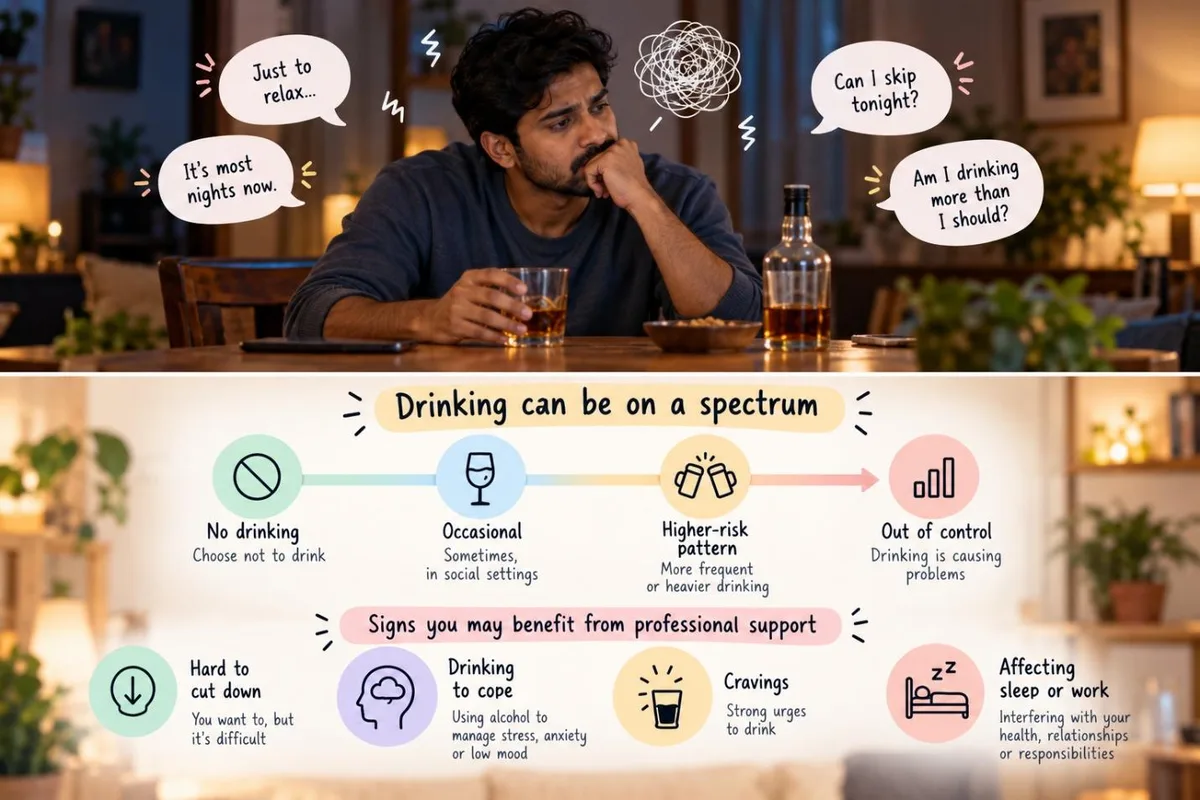
You started drinking just 2 pints to relax on a Friday but now you’re drinking most nights. You tell yourself you’ll not drink tonight but when it comes to it you find it easier to just have a drink.
You’re unsure if this is an issue. Many people around you drink more but you might be wondering when drinking becomes an issue?
As you are wondering this it is important to take note. This blog will explain how your drinking can develop, what signs to look out for, a quick self-assessment, simple ways to reduce your drinking and when you may need professional help, such as alcohol and substance abuse counseling. We are not judging, we are simply providing information to help you decide what feels right.
Drinking Is On A Spectrum
There isn’t a set point where drinking goes from being fine to bad. It is better to see it on a spectrum:
- No drinking
- Occasional and small amounts
- Drinking in ways that increase your risk of harm (for example: heavy drinking at the weekend or most days)
- Out of control drinking causing issues
At the top end of the spectrum doctors will refer to this as having an alcohol use disorder. This simply means you are finding it hard to control your drinking and continuing to drink despite it causing harm. It can be mild, moderate or severe. This is a health condition and not a character issue.
Even if you aren’t diagnosed with an alcohol use disorder many people will reduce their drinking as they notice it is affecting their sleep, mood, work and/or relationships.
Is Any Amount Of Alcohol Safe To Drink?
The World Health Organisation stated in 2023 there is no safe amount of alcohol to consume. Alcohol is linked to several cancers and there is no evidence of a safe cut off.
We just mean generally, the less you drink the better! Any reduction will help.
Why Your Drinking Can Increase Gradually
1. Drinking As A Coping Mechanism
Many people will increase their alcohol intake during times of stress. Whether it be a busy job, a break up, loneliness from moving cities or poor sleep. Although alcohol can provide you with quick relief it can disrupt your sleep and make you feel more anxious or low the next day. This makes you feel like you need a drink even more.
2. Tolerance
When you regularly drink alcohol your body will start to get used to the amount you are drinking. This is known as tolerance. You will start to need more to feel the same effect.
3. It Is Normal Within Your Circle
Going to office parties, weddings, having plans for the weekend and saying ek aur, yaar can make heavy drinking seem normal. If everyone around you is drinking heavily it will be harder to notice changes in your drinking.
4. Developing Routines
You might start drinking due to certain triggers. For example finishing work, a cricket game or sitting on your own after dinner. Once you have a routine it can become an automatic behaviour.
Signs You May Be Developing An Issue With Your Drinking
The US National Institute on Alcohol Abuse and Alcoholism have listed questions clinicians will ask to understand your drinking behaviour. Below are some of these questions put into simple terms. In the last year have you:
- Ended up drinking more or for longer than intended?
- Tried to cut down or reduce but found it hard?
- Spent a lot of time drinking, feeling poorly or recovering?
- Strong cravings?
- Had issues with work, study or family due to drinking?
- Continued to drink despite arguments with those close?
- Given up activities you enjoy to drink?
- Need more to feel the same effect?
- Feel shaky, sweaty, restless or unable to sleep when the effects wear off?
Answering yes to 1 or 2 of these does not mean you have an issue. Doctors will look at the overall picture but if 2 or more of these resonate with you it would be a good idea to speak to a professional.
Subtle Signs
- Hiding how much you are drinking or feeling defensive when asked
- Need a drink to relax, sleep or socialise
- Feel guilty or anxious about your drinking in the morning
- Family/friends have mentioned concerns
Simple Self-Assessment
The World Health Organisation have developed a short 10 question screening tool known as the AUDIT (Alcohol Use Disorders Identification Test). This is commonly used by doctors and counsellors. It asks how often and how much you are drinking and if it is causing any issues. This can highlight if your drinking is low risk or higher risk. This isn’t a diagnosis but is a great starting point for a conversation with a professional.
You can also try keeping a 2 week drinking diary. Each day write:
- What you were drinking and how much
- Where and who you were with
- How you were feeling just before your first drink
Often patterns will become clear very quickly. For example drinking more on busy work days or only when you are on your own.
Simple Ways To Reduce Your Drinking
- Set Clear Limits And Alcohol Free Days: Decide how much you will drink and which days you will not have any alcohol. Being vague with your goals such as ‘I will drink less’ can be easily forgotten by the evening.
- Work Out Why You Are Drinking: If you are using alcohol to relax, sleep or help with social anxiety plan an alternative. For example going for a walk, calling a friend, shower and chai or a wind down routine before bed.
- Change Your Environment: Do not keep alcohol in your home. Have a meal before having a drink, alternate with water and have smaller portions. Small changes can make a big difference.
- Have A Reason To Say No: Having a reason to say no will help. For example ‘I’m having a break this month’ or ‘I’m driving tonight’. Most people will actually care a lot less than you think.
- Tell Someone: Tell someone you trust what you are trying to do. It will make it easier to make changes with support.
When To Seek Help From A Professional
If you are struggling to reduce your drinking, using alcohol to cope with anxiety, low mood, stress or sleep, it is affecting your health, work or relationships or you are drinking whilst taking prescribed medication then it would be a good idea to seek support.
If you are drinking heavily everyday DO NOT attempt to suddenly stop drinking. Alcohol can cause withdrawal symptoms including shakiness, sweating, anxiety and in some cases seizures. Speak to a doctor first to help you reduce it gradually.
If you are experiencing withdrawal symptoms, struggling to reduce your drinking or also feeling depressed or anxious then a Psychiatrist would be a good first point of contact. They can assess your health and if required prescribe medication to help with your recovery. Having an online Psychiatrist consultation will make it easier to start this conversation. Alcohol and substance abuse counseling and Individual Therapy can help with underlying issues such as stress, loneliness or old habits and provide practical coping strategies.
If you or someone you know is in crisis please call Tele-MANAS on 14416 (free government mental health helpline) or 112 in an emergency.
Conclusion
Noticing your drinking isn’t to label you but to be honest with yourself. Making small gradual changes will help and you don’t have to do this alone.
If you would like support then our Psychologists and Psychiatrists can provide you with confidential online sessions to help you understand your drinking and create a plan to help you.
FAQs
When Does Drinking Become An Issue?
There is no set point but drinking can become an issue if it is difficult to control, you need more to feel the same effect or it is impacting your health, work, mood or relationships.
Is Drinking Every Night An Issue?
Drinking every day can increase your health risk and increase your risk of developing tolerance and dependence. Try having regular alcohol free days and take note if you struggle with this.
How Do I Know If I Am Drinking Too Much?
Try keeping a 2 week drinking diary and complete a screening tool such as the WHO AUDIT. If you are drinking more than intended or struggling to reduce then it would be a good idea to speak to a professional.
Is It Safe To Suddenly Stop Drinking?
If you are drinking heavily everyday it is not safe to suddenly stop. Alcohol can cause withdrawal symptoms which can sometimes be serious. Speak to a doctor or Psychiatrist first to help you reduce gradually.
Who Should I See For Drinking Issues?
A Psychiatrist can assess your physical and mental health and manage your withdrawal or medication. A Psychologist/Counsellor can help with the underlying issues such as stress, habits or emotions. Many people benefit from seeing both.
Can Therapy Help With Alcohol Use?
Yes! Alcohol and Substance Abuse Counseling can help you understand your drinking patterns, manage triggers and create other coping strategies. It can also support family members who may be concerned about someone’s drinking.
References
-
Babor, T.F., Higgins-Biddle, J.C., Saunders, J.B. and Monteiro, M.G., 2001. AUDIT: The Alcohol Use Disorders Identification Test: Guidelines for use in primary health care (2nd ed.). World Health Organization. Available at: https://www.who.int/publications/i/item/WHO-MSD-MSB-01.6a
-
National Institute on Alcohol Abuse and Alcoholism. (n.d.). What are the symptoms of alcohol use disorder (AUD)? Rethinking Drinking. Available at: https://rethinkingdrinking.niaaa.nih.gov/how-much-too-much/what-are-symptoms-alcohol-use-disorder-aud
-
NHS Borders. (n.d.). Advice for heavy drinkers, cutting back or stopping alcohol use. [Patient leaflet]. Available at: https://nhsborders.scot.nhs.uk/media/1002313/Advice-for-heavy-drinkers-.pdf
-
World Health Organization Regional Office for Europe. (2023, January 4). No level of alcohol consumption is safe for our health. [News release on WHO’s statement in The Lancet Public Health]. Available at: https://www.who.int/europe/news/item/04-01-2023-no-level-of-alcohol-consumption-is-safe-for-our-health
-
Ministry of Health and Family Welfare, Government of India. Tele-MANAS. Available at: https://telemanas.mohfw.gov.in
