 Skip to content
Why Gen Z Employees May Hesitate to Discuss Mental Health at Work
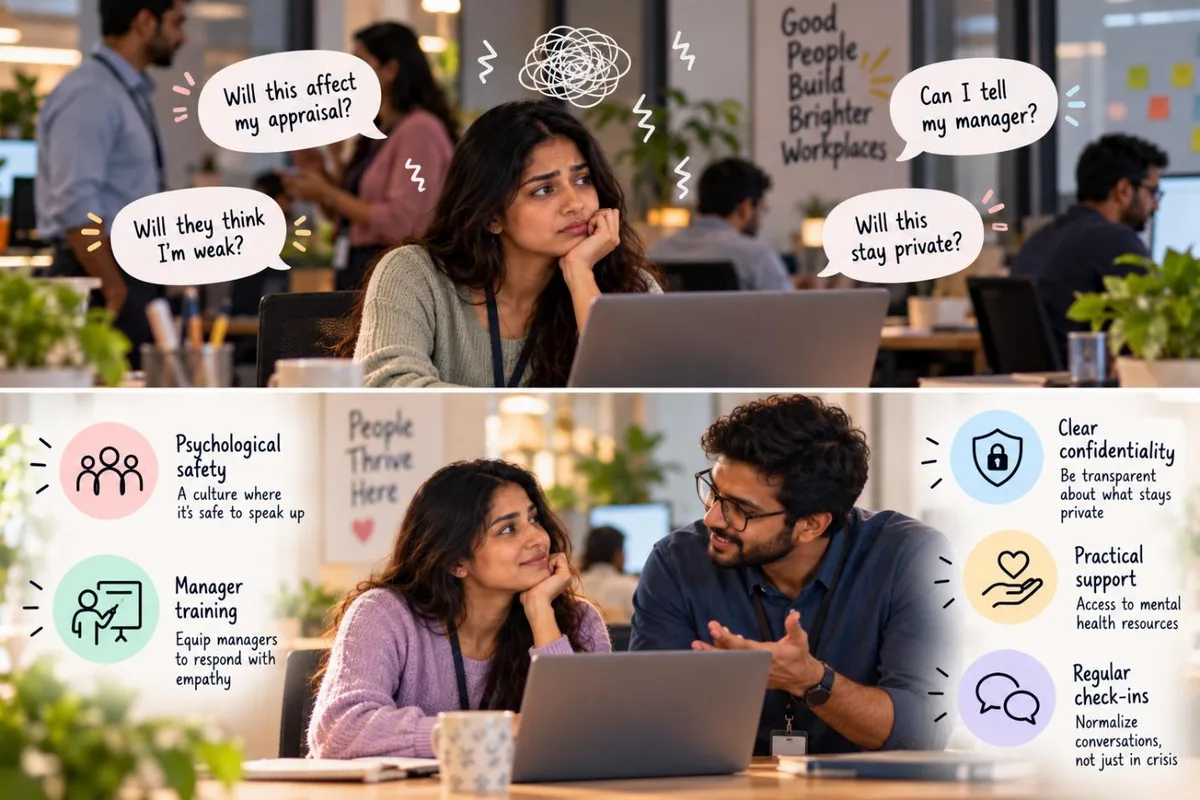
Ananya is 24. She has therapists she follows on Instagram and is very open with her friends about her anxiety. However, when her manager asked why she missed a deadline last week she replied: “Just got a headache.”
This is not uncommon. While Gen Z are often considered the ‘open’ generation when it comes to mental health, many young employees remain silent.
In this blog we look into why this may be the case and how managers, HR teams and young employees can address it.
The Paradox of Being Open
Gen Z, born around the late 90s to early 2010s, have grown up discussing mental health online and many are very open to words like ‘anxiety’, ‘burnout’, ‘boundaries’ and ‘seeing a therapist’.
There is often high amounts of stress in this generation. Around a third (34%) of Gen Z respondents in Deloitte’s 2026 Gen Z and Millennial Survey reported feeling anxious or stressed most or all of the time. This has decreased from 40% in 2025 however, means that this is still a large portion of young employees.
While talking about mental health with friends can be seen as very open and safe, talking to your manager may feel risky.
While Gen Z is not a homogenous group and can vary greatly depending on their background, industry, city and personality, there are some common reasons as to why Gen Z employees may be hesitant.
Reasons Why Gen Z Employees May Be Hesitant
1. Fearing they will appear less competent
At the beginning of their careers many people feel they need to prove themselves. Many people will be hesitant to disclose due to fearing discrimination. A 2012 review of research into reasons for not disclosing found that the main issues were fear of losing credibility, impacting promotions, gossip and being treated differently.
2. New and little security
Many interns/trainees/probationers or those on short-term contracts will feel they have little to ask for. Without much of a history, it can feel like you have more to lose.
3. Not sure what will be kept confidential
If you’re unsure what will happen to the information you will assume the worst. Will this go onto your file? Will your manager tell the team? Will this come up in your appraisal? Many people will be hesitant to speak up due to uncertainty.
4. Mixed Messages
If your company is posting about World Mental Health Day but sending messages at midnight expecting a quick reply, young employees will notice. If there is a discrepancy between campaigns and culture, they will tend to believe the culture.
5. Hierarchical and multiple generations
Many Indian workplaces place a great deal of value on seniority. Personal issues are not usually discussed with a manager. Some senior managers may have grown up believing they should push through stress. A young employee may feel they won’t be understood or that they will be seen as complaining.
6. They don’t want to be seen as too sensitive
As there are lots of jokes online about Gen Z being delicate or ‘quiet quitters’ some young employees may be extra cautious. Some will remain silent to not fit a stereotype.
How to Create a Culture of Trust
The same review found that people were more likely to speak up if they felt emotionally supported and had positive previous conversations. Creating a culture of trust can be done with little effort.
1. Create a Culture of Psychological Safety
Psychological safety means everyone in the team feels safe to be open, ask questions and make mistakes without embarrassment or repercussions. Research by Harvard researcher Amy Edmondson shows that teams with psychological safety will learn more and will be more open. Managers can create this by staying calm when hearing bad news and thanking employees for speaking up.
2. Train Managers to Start the Conversation
According to World Health Organization guidelines on mental health in the workplace, managers should be trained to help employees with their mental health. Opening with a simple statement such as “I’ve noticed you’ve been busy recently. How are you really?” will help. Managers don’t need to be counsellors they just need to be good listeners, non-judgmental and know where to refer.
3. Be Clear on Confidentiality
Be clear to employees who will have access to what information. Let them know how the Employee Assistance Programme works, what information will be shared with the company (usually just how many people used the service anonymously) and what managers will and won’t know.
4. Focus on Support
No one should need to disclose a diagnosis. It should be normal to ask for practical help. For example: flexible working hours, temporary changes to workload or clarity on priorities.
5. Be in Alignment with the Message
If you are running awareness campaigns you must ensure they are reflected in everyday practise. Acknowledge their time outside of work, set realistic deadlines and recognise if someone is overloaded.
6. Give Multiple Options
Some people will want to talk to their manager while others will prefer to speak to HR, a peer listener or completely externally. Providing confidential online therapy sessions through corporate mental health programmes will allow them to get the support they need.
7. Lead by Example
If a senior leader mentions they took time off last year for their mental health it will mean more than any posters. It shows that asking for help won’t impact their career.
If you are a Gen Z employee considering whether to speak up:
- You don’t need to tell anyone your diagnosis. Just say what will help the conversation.
- Focus on the impact it’s causing and ask for specific help. For example: “I’ve been struggling with some health issues which are impacting my focus. Can we change my deadlines for the next two weeks?”
- Check what options are available. Have a look at your leave policy and check if you have an EAP.
- Choose the right person. This might be your manager, a skip level manager, HR or a mentor you trust.
- Get external support. A therapist can help you decide what, when and how much you want to disclose.
When to see a Professional
Consider seeing a psychologist if:
- You’re feeling anxious, low or tired most days for longer than 2 weeks.
- Work related stress is impacting your sleep and eating habits or relationships.
- You dread Mondays or can’t keep up no matter what you do.
- You’re relying on alcohol, food or endless scrolling to get by.
- You’re feeling lonely or hopeless.
Online therapy sessions can be a great first step to getting help privately.
If you are in crisis or know someone who is please call Tele-MANAS (14416) free mental health helpline provided by the government or 112 in an emergency.
Conclusion
Gen Z are not reluctant to discuss mental health. Many young employees are considering if it is safe to do so. If managers are good listeners, clear on confidentiality and provide support without needing a diagnosis, many will move from being silent to having honest conversations. This is where real support begins.
Our corporate mental health programmes provide employees with confidential access to psychologists online. We can also help organisations create a culture where asking for help is safe. If you are leading HR or a team we’d be happy to chat to you about what we could do for your workplace.
FAQs
Why don’t employees discuss their mental health?
Common reasons include fear of appearing less competent, worrying about promotions and job security, confusion around confidentiality and mixed messages from the workplace.
Is Gen Z more open?
Many Gen Z people will be more open about their mental health in their personal lives. However, they may be hesitant to discuss it at work, especially early in their careers or if unsure how their manager will react.
Should I tell my manager?
This is a personal decision. If you choose to, don’t mention your diagnosis. Mention the impact it is having and ask for specific support. Have a look at your company policies and EAP first. Choose someone you can trust.
How can managers support Gen Z employees?
Be proactive, be a good listener, encourage asking for adjustments, respect their time outside of work and know where to refer them for confidential support.
What should be included in corporate mental health programmes?
Confidential counselling, trained managers, clear confidentiality policies, realistic workload and leaders modelling healthy behaviour. The best programmes will impact everyday culture.
Can I get therapy privately?
Yes! You can book your own private online therapy sessions. Most EAPs in the workplace are also confidential and will usually only share anonymous data with employers. Check your company policy.
References
- Brohan, E., Henderson, C., Wheat, K., Malcolm, E., Clement, S., Barley, E. A., Slade, M., & Thornicroft, G. (2012). Systematic review of beliefs, behaviours and influencing factors associated with disclosure of a mental health problem in the workplace. BMC Psychiatry, 12, 11. https://doi.org/10.1186/1471-244X-12-11
- Deloitte. (2026). Gen Z and Millennial Survey: World Mental Health Day insights. https://www.deloitte.com/global/en/issues/work/world-mental-health-day.html
- Edmondson, A. (1999). Psychological safety and learning behavior in work teams. Administrative Science Quarterly, 44(2), 350–383. https://doi.org/10.2307/2666999
- World Health Organization. (2022). WHO guidelines on mental health at work. https://www.who.int/publications/i/item/9789240053052
- Ministry of Health and Family Welfare, Government of India. Tele-MANAS. https://telemanas.mohfw.gov.in
