 Skip to content
Why Am I Mentally Exhausted Even When I Haven’t Done Much?
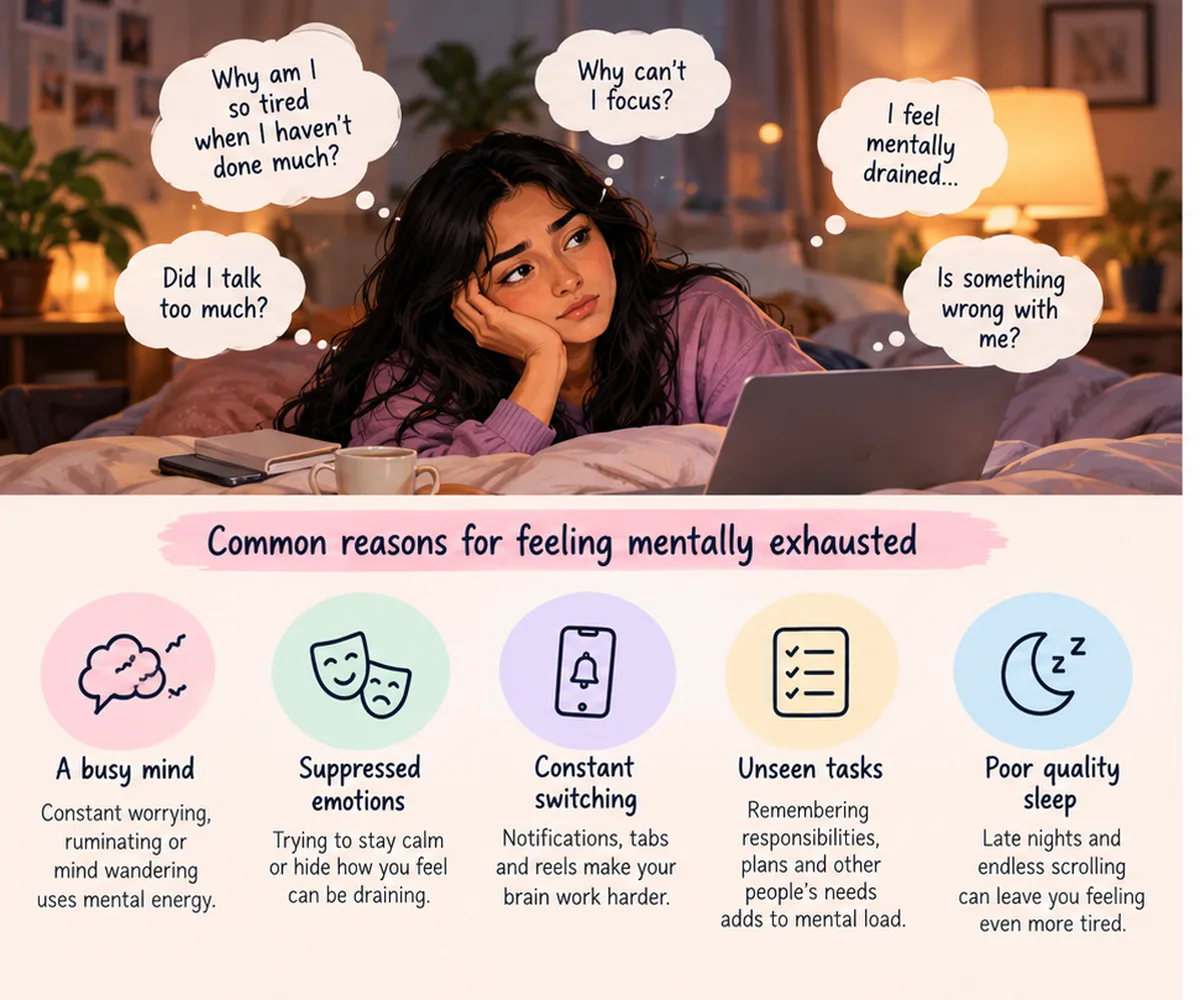
I didn’t do anything today. No going out. No work. Just sat in bed, scrolling my phone, eating and watching half a series. Yet I feel totally drained as if I ran around all of Mumbai in peak traffic.
What’s wrong with me? Why am I so tired?
You aren’t lazy and it’s not your imagination if you often feel mentally tired. A lot of what we do can drain our mental energy and this blog will explain what is happening in the background to drain your energy and what signs to look out for and how you can recharge.
Mental energy
Often we equate how tired we are with how much we’ve been doing. However, our brain can still use a lot of energy!
1. Your brain is busy
A well known study at Harvard had over 2,000 people get pinged on their phones at random times throughout the day. They found that almost half (46.9%) of the time their mind was wandering. This also tended to cause them to feel less happy.
If a lot of your mind is wandering and you’re worrying, replaying conversations in your head or trying to plan for potential issues then this can cause you to feel tired. Stress and worry are common psychological reasons for feeling constantly tired according to the National Health Service (NHS) in the UK.
2. Suppressing emotions
Trying to smile through a tense family meal, staying calm with an unfair manager or hiding your sadness from friends can all take a lot of energy. In a series of experiments, those asked to suppress their emotion weren’t able to recall as much from what they had just seen. Researchers suggested that this is because you need to constantly monitor your emotions meaning you use up mental energy.
3. Switching tasks
Constant notifications, multiple tabs, reels, messages and incomplete tasks can make your brain switch between tasks. The American Psychological Association notes that switching tasks can cause your brain to use energy. Whilst scrolling can feel relaxing, you’re likely to be switching between thousands of small tasks.
4. Unseen tasks
Remembering everyone’s birthday, meal planning, bill reminders, caring for a parent, worrying about a sibling and an unresolved argument all take a toll mentally and emotionally. These tasks rarely appear on a to do list.
5. Poor quality sleep
Whilst lying in bed on your phone does not count as a break. Poor quality sleep, sleeping late and endless content can make you feel even more drained.
6. Depression, anxiety or physical issues
Constant tiredness could be a sign of depression, anxiety or a physical issue such as anaemia or thyroid issues. If you’ve been feeling tired for weeks then it’s worth talking to your doctor.
Signs you’re mentally drained
- Feeling tired despite having a good nights sleep.
- Difficulty concentrating, reading or listening.
- Feeling overwhelmed by small decisions.
- Getting easily irritated.
- Wanting to be alone or avoiding messages/calls.
- Procrastinating on basic tasks.
- Not feeling relaxed but more flat/numb.
Ways to recharge your mind
1. Write it down
Write down everything that is on your mind. This can help make the unseen tasks feel more manageable as you can actually see them.
2. Complete, schedule, ask for help or forget
For every item on your list choose to complete it (if it takes less than 5 minutes), schedule it, ask for help or forget about it. This will stop your brain being distracted by unfinished tasks.
3. Take a break
Try to take a real break:
- Go for a walk outside, preferably somewhere green. A study at the University of Michigan showed those who had walked in a park performed better in a memory and concentration task. Whereas those who had walked downtown did not get any improvement.
- Lie down with your eyes closed for 10 minutes.
- Listen to some music.
- Chat to someone you like in a relaxed manner.
4. Express your emotions
Don’t try to push your emotions down. Try to write down how your day went, chat to a friend or just tell yourself you’re feeling frustrated and it makes sense. The same research into emotions showed that re-evaluating a situation did not have the same impact on your brain.
5. Minimise switching
Turn off any unnecessary notifications. Only have 1 tab open whilst working. Check messages at specific times. This will help you concentrate for much longer.
6. Minimise decision making
Create simple routines. For example weekly meal planning, waking up at the same time everyday and having a go-to outfit. Every decision you don’t have to make will save some mental energy.
7. Look after yourself
Having a routine with sleeping and waking up, eating properly, drinking water and getting some movement everyday will help.
Remember that taking a break isn’t being lazy. If you’ve been worrying, having emotions and carrying responsibility throughout the week then you’ve done a lot!
When to seek professional help
If you’ve been feeling very tired most days for over 2 weeks, aren’t seeing any improvement with breaks and sleep, losing interest in things you used to enjoy, feeling low/anxious most of the time or your tiredness is impacting your work/studies/relationships then it might be worth talking to a professional.
Start with talking to your doctor to rule out any physical issues. If your tiredness is due to stress, worry or low moods then stress management and counselling can help you understand what is causing you to feel drained and create practical ways to recharge. If you’re also feeling like you’ve lost interest in most things then our blog Why am I always tired of everything might help.
If you ever have any thoughts of self harm please reach out. In India you can call the free government Mental Health Helpline Tele-MANAS on 14416. In an emergency call 112.
Conclusion
Mental tiredness is real! Often there are many unseen reasons why you might feel this way. Worrying in the background, suppressing emotions, constantly switching between tasks and having unseen responsibilities all take up your limited mental energy. By identifying what is causing you to feel this way, taking real breaks and seeking help you can start to feel like yourself again.
If you’re feeling drained and can’t work out why then our psychologists can help you understand what is causing you to feel this way with confidential online sessions.
FAQs
Why am I mentally tired for no reason?
There is usually a reason for it. Often it’s because you’re worrying in the background, suppressing your emotions, switching between tasks and screens constantly and having unseen responsibilities. It can also be linked to low moods, anxiety or physical issues.
What are the symptoms of mental tiredness?
Common symptoms include difficulty focussing, feeling overwhelmed by small decisions, getting easily irritated, lacking motivation, wanting to be alone and feeling tired after sleep.
How can I recharge my mental energy?
Write down what is on your mind, complete any open loops, take a proper break such as a walk outside, express your emotions, minimise notifications and look after your sleep, eating and movement. If it’s lasting for weeks then seek professional help.
Can overthinking make me tired?
Yes! Constant worrying and thinking about things can mean your brain is busy even when you’re sat still. Overthinking therapy can help you become aware of and break your patterns.
Can mental tiredness be a sign of depression?
It can be. Especially if it’s accompanied by low moods and loss of interest in things for over 2 weeks. It can also be caused by stress, anxiety or physical issues so it’s worth getting checked.
Can stress management and counselling help?
Yes! Counselling can help you identify what is causing you to feel drained, create boundaries, manage your worry and create routines to help you recharge.
References
- American Psychological Association. (2006). Multitasking: Switching costs. https://www.apa.org/topics/research/multitasking
- Berman, M. G., Jonides, J., & Kaplan, S. (2008). The cognitive benefits of interacting with nature. Psychological Science, 19(12), 1207–1212. https://doi.org/10.1111/j.1467-9280.2008.02225.x
- Killingsworth, M. A., & Gilbert, D. T. (2010). A wandering mind is an unhappy mind. Science, 330(6006), 932. https://doi.org/10.1126/science.1192439
- NHS. (n.d.). Why am I tired all the time? https://www.nhs.uk/live-well/sleep-and-tiredness/why-am-i-tired-all-the-time/
- Richards, J. M., & Gross, J. J. (2000). Emotion regulation and memory: The cognitive costs of keeping one’s cool. Journal of Personality and Social Psychology, 79(3), 410–424. https://doi.org/10.1037/0022-3514.79.3.410
- Ministry of Health and Family Welfare, Government of India. Tele-MANAS. https://telemanas.mohfw.gov.in
