 Skip to content
Relationship Overthinking: How to Stop Reading Too Much Into Text Messages
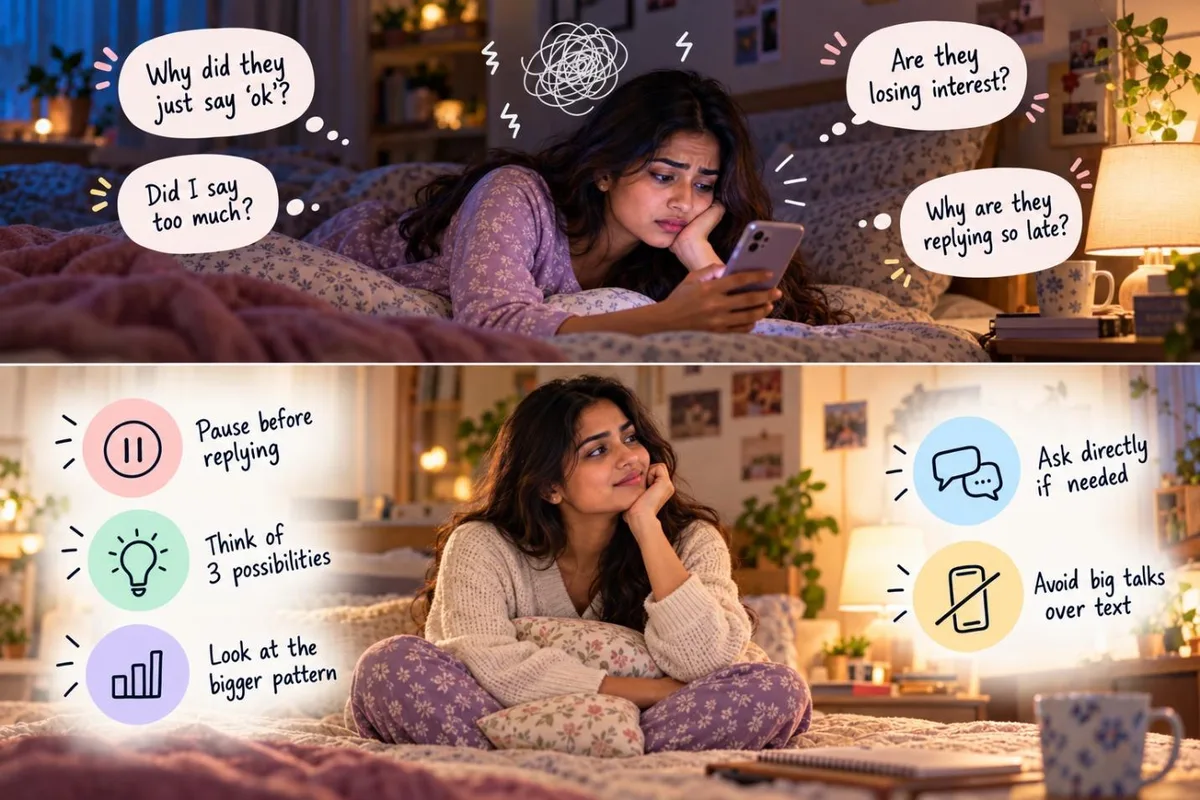
You sent them a long message to catch up, but they responded with “ok”.
Your brain goes into overdrive. Did they get angry? Did I say the wrong thing? They never used to respond with just hearts. Something is off. You draft a response, delete it, check their last seen, and start reading through the whole chat again.
This is a very common way people overanalyze situations in their relationships. With couples relying heavily on texts to communicate, it can cause many issues. In this blog, we will explore why texts can be a tricky thing to interpret, how to stop getting caught up on the two-letter response, and when to seek professional help, such as relationship counselling or couples therapy.
Why texts can be confusing
1. Lots of missing information
When communicating face-to-face we can hear the tone in someone’s voice, see their facial expressions and body language. When using texts almost all of this is lost. An “ok” with a smiley face and “ok” with a sigh would look identical.
A well known study carried out in 2005 found that participants sent short messages to others, either with a sarcastic tone or serious tone. The senders believed their recipient would be able to understand the tone correctly approximately 78% of the time. However, when sending over email this dropped to around 56%, which is not much better than guessing. When sending over voice people performed a lot better. Both the sender and recipient were overly confident they could understand each other.
This was due to egocentric thinking meaning when sending a message you imagine you are saying it with the correct tone and forget they cannot hear it.
2. Your brain fills in the gaps
When there is missing information your brain will automatically fill the gaps in. If you are feeling confident you may think they are busy. However, if you are feeling anxious you are more likely to think they are losing interest.
3. Everyone texts differently
Some people write long paragraphs with emojis. Others will reply with one word, even if they are feeling amazing. Some people reply really quickly whilst others will only check their phone twice a day. Often a short or delayed response is down to their texting style, how busy they are or how they are feeling.
4. Attachment anxiety
Attachment anxiety is when people tend to worry about being rejected or abandoned by those close to them. This often comes from past experiences of inconsistent care or painful relationships.
Those with higher levels of attachment anxiety tend to be more attuned to looking for signs of them pulling away. Research into social media has shown that those with higher levels of attachment anxiety reported increased levels of jealousy and checked their partners’ profiles more often. This is due to them having less trust in their partner. This can often happen with texts, last seen, and blue ticks.
5. Reassurance-seeking cycle
By reading through the chat or asking them “Are you upset with me?” you can feel an instant sense of reassurance. However this will fade and next time you will feel a little more worried. This is known as a reassurance-seeking cycle and can become a habit.
The impact on your relationship
Overanalyzing texts can cause:
- Pressure to send follow up messages
- Arguments about why they responded in a certain way
- Hiding how you truly feel so you don’t seem like too much
- Taking your focus away from the time you actually spend together
They may not even realise anything is wrong but you have spent the whole day overanalyzing.
How to stop overanalyzing texts
- Take a break: If you feel your stomach drop when reading a message take a 15-20 minute break before replying or sending another message. Your emotions will settle and you will reply in a calmer manner.
- Think of 3 possibilities: Write down 3 reasons why they responded with an “ok”. Maybe they are in a meeting, they are tired or they just text like that. Most likely one of the neutral reasons will be the true reason.
- Look at the overall pattern: Ask yourself how they treat you in general. Are they showing up, making plans and caring for you outside of texts? One short text won’t undo weeks of consistent behaviour.
- Get to know their texting style: Have a relaxed conversation with them about how you both text. “Sometimes I overanalyze short responses. How do you usually text when you’re busy?” Knowing they tend to reply with one word whilst working can prevent you from worrying.
- Ask them directly: If you genuinely feel something is off ask them directly. “You seemed quiet today, are you ok?” Trust their answer.
- Avoid important conversations: Try to avoid having disagreements, major decisions or hurt feelings over texts. Try to have these over a call.
- Limit checking: Mute the chat for an hour, turn off last seen notifications or put your phone in another room whilst doing something you enjoy. Every time you stop yourself from checking it will get a little easier.
- Notice what is really going on: If they reply slowly and you feel an intense fear, ask yourself where have you felt this before? Often the panic isn’t really about the text but about old hurts. Write it down to help identify the pattern.
When to speak to a professional
If you are spending hours worrying about texts, feeling intense panic if they don’t reply quickly, constantly checking what they are up to, where they are or their social media, constantly having the same arguments about texts or if you have a fear of being left in most of your relationships, you may want to speak to a professional.
Therapy can help you understand your triggers and change how you respond to them. If it is impacting both of you, relationship counselling or online couples therapy can help you discuss your needs, build trust and improve communication with a neutral guide.
If your partner is using texts to control, threaten or monitor you this isn’t overanalyzing. Please reach out to someone you trust. In an emergency in India please call 112. For mental health support you can call Tele-MANAS on 14416 (a free government helpline).
Conclusion
Texts do not contain as much information as we think. Our anxious minds will fill in the gaps with the worst story. Taking a break, thinking of other possibilities, learning each other’s texting styles and having important conversations over the phone can help create a calmer relationship.
If you are feeling pressured due to overanalyzing, Zenup Health’s psychologists can provide confidential online therapy sessions (individual or couple) to help you feel more secure and connected.
FAQs
Why do I overanalyze my partners texts?
Texts don’t have any tone or facial expressions so our brains fill in the gaps. If you are prone to worrying about rejection you are more likely to fill in the gaps with negative thoughts.
What does a short response mean in a relationship?
Often much less than you think! People will often reply with short messages if they are busy, tired, distracted or just their texting style. Look at the overall pattern of the relationship.
How can I stop overanalyzing texts?
Take a break, think of a few neutral reasons, ask them directly if you feel something is off and have important conversations over the phone. Limit how much you check.
Is it normal to feel anxious if my partner doesn’t reply?
A little worry is normal especially in the early stages of a relationship. However if it is causing you panic, constant checking or frequent arguments you may want to look into it with a professional.
Can relationship counselling help with overanalyzing?
Yes! Relationship counselling can help couples understand each other’s communication styles and needs. Individual therapy can also help with managing the anxiety.
Should I tell my partner I overanalyze texts?
Yes it can help. If you tell them in a calm manner and explain your worries you can reduce any misunderstandings. Asking how they usually text can help both of you feel more relaxed.
References
- Kruger, J., Epley, N., Parker, J., & Ng, Z.-W. (2005). Egocentrism over e-mail: Can we communicate as well as we think? Journal of Personality and Social Psychology, 89(6), 925–936. https://doi.org/10.1037/0022-3514.89.6.925. Summary: Winerman, L. (2006, February). E-mails and egos. Monitor on Psychology, 37(2). https://www.apa.org/monitor/feb06/egos
- Marshall, T. C., Bejanyan, K., Di Castro, G., & Lee, R. A. (2013). Attachment styles as predictors of Facebook-related jealousy and surveillance in romantic relationships. Personal Relationships, 20(1), 1–22. https://doi.org/10.1111/j.1475-6811.2011.01393.x
- Ministry of Health and Family Welfare, Government of India. Tele-MANAS. https://telemanas.mohfw.gov.in
