 Skip to content
Questioning Your Identity? Understanding Your Emotions Without Rushing Labels
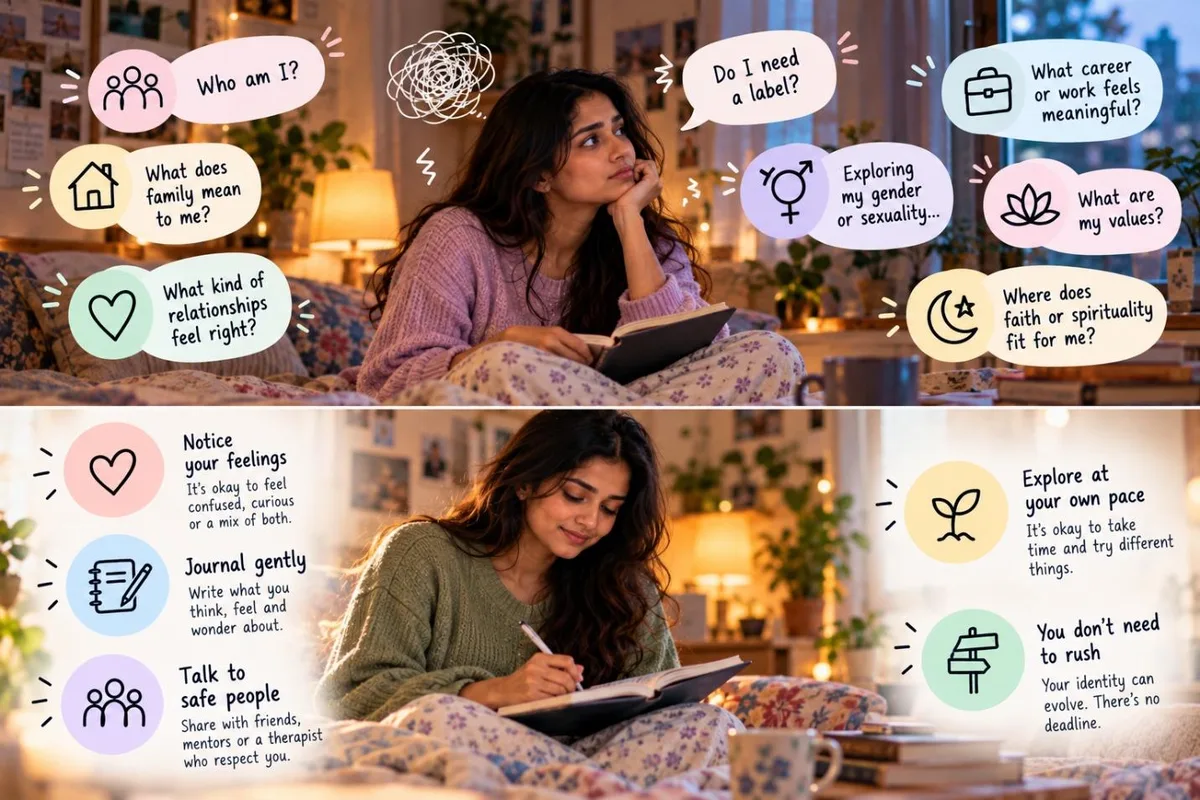
This could be something small, such as having a crush that took you by surprise, or realising that you don’t want the same thing as everyone else at your friend’s wedding. Or perhaps you chose a ‘safe’ degree but are now sitting in lectures feeling like you aren’t living your life.
You might be asking yourself:
Who am I?
If you are questioning your identity then there is nothing wrong with you. It is one of the most human things we can do. We will look at why this happens, the emotions you might feel and some gentle ways to explore your feelings.
What does it mean to question your identity?
Your identity is how you see yourself. This can include your values, beliefs, relationships, culture, faith, career, interests, sexual orientation and gender identity.
You could be questioning your identity in one or more of these areas. You might feel unsure about:
- Do I actually believe what I was brought up to believe?
- Is my career really what I want? Or is it what my parents want?
- Why am I attracted to people I don’t expect?
- Why don’t I feel like people see me as the gender I feel?
- Who am I outside of this relationship/job/family role?
All of these questions are equally valid.
Why do we question our identity?
1. It is part of growing and developing
Psychologists have long recognised that our identity is something we develop throughout our lives. Psychologist Erik Erikson described figuring out who we are as a core aspect of our development.
Later, psychologist Jeffrey Arnett coined the term emerging adulthood, describing how during our late teens and early 20s we try out different options in love, careers and worldviews. During this time questioning our identity is completely normal.
Many people will question their identity in their 30s, 40s and beyond.
2. Major life changes
Major life changes can cause us to question our identity:
- Moving to a new city for college or work
- Starting/ending a relationship
- Talking about marriage at home
- Becoming a parent or deciding not to
- Losing a job, loved one or long-term plan.
As your life is changing around you, your previous answers to who you are may no longer apply.
3. New people, new language and new opportunities
Meeting people from diverse backgrounds, reading widely and learning new languages can make us rethink who we are. Sometimes seeing a word, story or having a conversation can help us realise what we have been feeling for years.
4. Expectations within many Indian families
Many Indian families have clear expectations for people. This can include going to the right degree, right career, getting married by a certain age. So when we don’t feel like we match up to these expectations we often feel worried about disappointing those we love.
5. Sexual orientation & gender identity
Questioning your sexual orientation and/or gender identity is completely natural. Being lesbian, gay, bisexual, transgender, queer, intersex, asexual or other identities are not illnesses or issues to be fixed. Major professional bodies such as the American Psychological Association support positive approaches to care.
There is nothing to commit you to when exploring these questions. You can explore honestly.
Emotions you may feel
Rarely will we question our identity without feeling some emotions. You may feel:
- Confused
- Anxious about how it might affect your family, friends or future.
- Relieved or excited that something finally makes sense.
- Guilty that you are questioning your identity and betraying those who raised you.
- Lonely as no one around you seems to be questioning.
- Sad to let go of an old version of yourself.
You might feel multiple of these emotions in one day. This does not mean you are doing anything wrong. It means something important is happening.
Why you shouldn’t rush to label yourself
Labelling can be amazing. Finding the right word can make you feel relieved, accepted and part of a community. For many people finding a label is a pivotal moment.
However, the pressure to label can cause anxiety. This could be pressure from yourself, social media or those around you.
It is completely okay to say you are still figuring it out. It is also okay to label yourself now and understand yourself more in the future. As time goes on you will understand yourself more.
How to explore your identity at your own pace
1. Use ‘feeling’ language
Try to ask yourself ‘What am I noticing?’ instead of ‘What am I’. Have a quick journal entry using ‘This week I felt ___ when ___’. Remember that feelings are information and you don’t have to have an answer for everything.
2. Notice when you feel most like yourself
At the end of each day for a week, write down one instance when you felt most like yourself and one instance when you felt least like yourself. See if there are any patterns.
3. Ask whose voice it is
Whenever you feel a strong should in your head ask yourself whose voice it is. Is it your parent, teacher, friend or society? Whilst you can still value this opinion, knowing it is coming from somewhere else will help you separate their expectations from your feelings.
4. Find one safe person/place
You don’t have to tell everyone. Find one person who will listen without judging or a supportive community. If you are joining online communities then ensure your privacy is protected, especially if you aren’t ready for people at home to know.
5. Use the internet wisely
Reading other people’s stories can help you feel less alone. However, quizzes and comments online cannot tell you who you are. Ensure you are using reliable sources and trust your own experiences.
6. Set aside time
If your mind is racing at night then set aside 15 minutes in the evening to write or reflect. Remind yourself gently that you will come back to it later. Having a good night’s sleep, eating and moving will help you think clearly.
7. Decide who to tell
This is up to you. Consider your safety, support system and when you want to tell people.
When to seek professional help
If you are feeling anxious, low or overwhelmed most days,
- Having trouble sleeping, studying, working or eating.
- Pulling away from friends or feeling very lonely.
- Conflict or pressure at home.
- Not feeling safe to be yourself where you live.
A good therapist will not tell you who you should be. Individual therapy provides you with a private and non-judgmental space to work through your feelings at your own pace. If you are questioning your sexuality or gender then try to find an lgbtq counsellor who is affirmative. An affirmative professional will respect your identity.
Conversion therapy (trying to change someone’s sexual orientation/gender identity) is damaging. In 2022 the National Medical Commission in India declared it as professional misconduct.
If you ever have any suicidal thoughts please seek help immediately. In India you can call Tele-MANAS (free government mental health line) on 14416. Or 112 in an emergency.
Conclusion
Questioning your identity is not a crisis to be solved. It is a way of learning more about yourself. Pay attention to your feelings, find some safe people and allow yourself to take your time. Often the answers you come to will feel like home.
If you would like support whilst exploring your identity then our psychologists at Zenup Health offer private online sessions. We offer LGBTQIA+ affirmative counselling in a safe, confidential and judgement-free space, at a pace that feels right for you.
FAQs
Is it normal to question your identity?
Yes. Many people question their values, career, relationships, sexuality and/or gender at various points in their lives. Especially during life changes. It is completely normal to question your identity.
How do I know who I really am?
Often there won’t be one defining moment. Take notice of when you feel most and least like yourself. Separate your feelings from others expectations and take your time. Usually you will come to understand yourself gradually.
Do I need to label myself?
No. Some people find it helpful to label themselves. Others prefer to explore without a label. Both are valid and you can come back to labelling when you learn more about yourself.
What if I’m questioning my sexuality/gender?
This is completely natural and part of human diversity. Take your time, find some safe people and reliable information. Only share with people when you are ready.
Can therapy help with confusion around my identity?
Yes. Individual therapy will provide you with a private space to explore your feelings. If you are questioning your sexuality/gender then look for LGBTQ counselling from an affirmative psychologist.
Can therapy change my sexual orientation/gender?
No. Ethical therapy will not attempt to change who you are. Trying to change someone’s sexual orientation/gender is damaging and often referred to as conversion therapy. Professional bodies do not support this. In India it is considered professional misconduct by the National Medical Commission.
References
American Psychological Association. (2021, March 2). Press release: Resolution on Gender Identity Change Efforts and updated Resolution on Sexual Orientation Change Efforts Adopted February 26, 2021. https://www.apa.org/news/press/releases/2021/03/change-gender-identity
Arnett, J. J. (2000). Emerging adulthood: A theory of development from the late teens through the twenties. American Psychologist, 55(5), 469–480. https://doi.org/10.1037/0003-066X.55.5.469
Erikson, E. H. (1968). Identity: Youth and crisis. W. W. Norton.
Jurist. (2022, September). India National Medical Commission declares conversion therapy ‘professional misconduct’. https://www.jurist.org/news/2022/09/india-national-medical-commission-declares-conversion-therapy-professional-misconduct/
Nakamura, N., Dispenza, F., Abreu, R. L., Ollen, E. W., Pantalone, D. W., Canillas, G., Gormley, B., & Vencill, J. A. (2022). The APA guidelines for psychological practice with sexual minority persons: An executive summary of the 2021 revision. American Psychologist, 77(8), 953–962. https://doi.org/10.1037/amp0000939
Ministry of Health and Family Welfare, Government of India. Tele-MANAS. https://telemanas.mohfw.gov.in
