 Skip to content
How to Set Boundaries With Your Parents Without Feeling Guilty
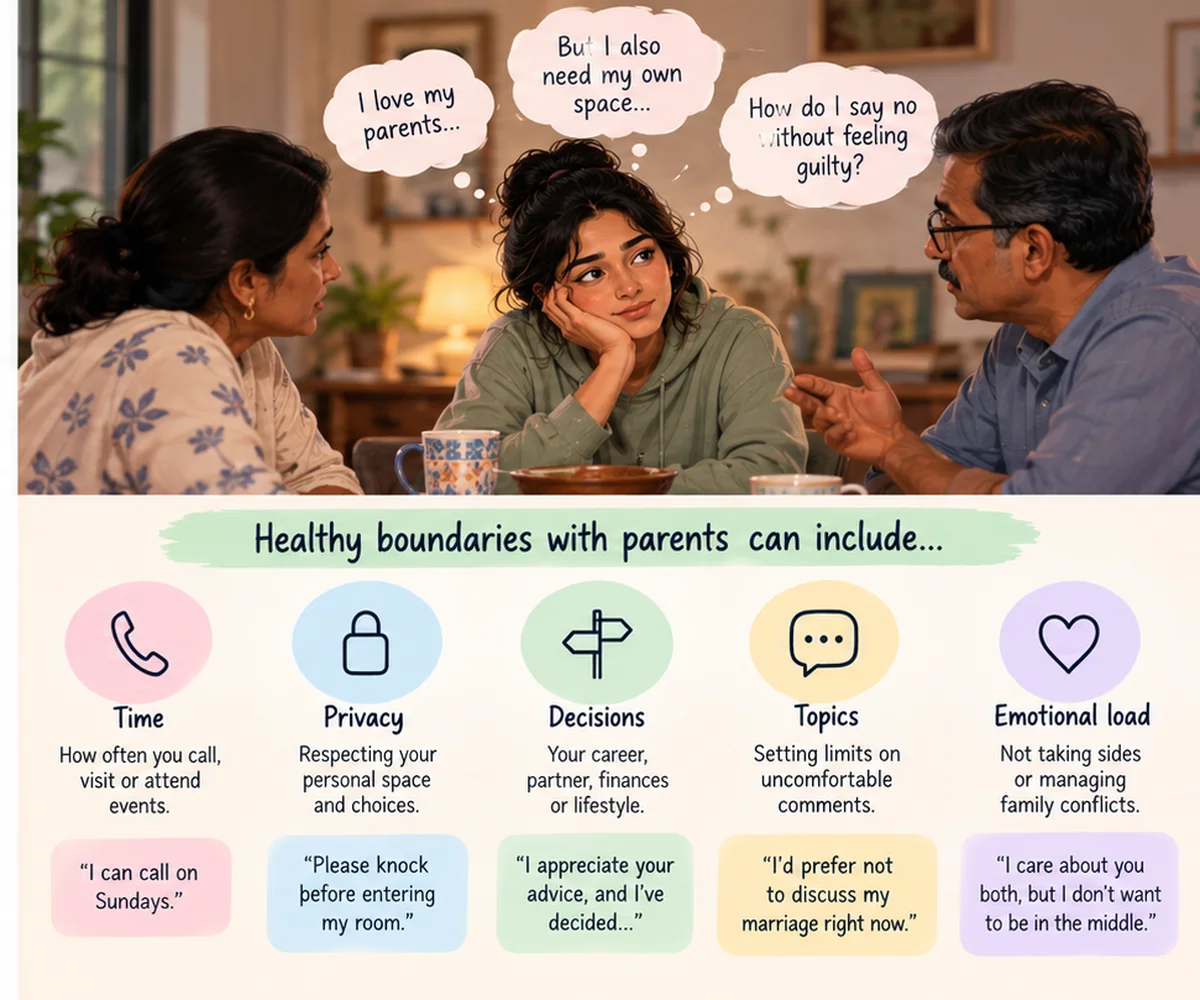
It’s the third call of the day. “Where are you? Have you eaten? When are you coming home?” Later at dinner, a relative’s son’s wedding comes up, followed by a pointed look in your direction. Your weekend has already been planned for you.
You love your parents. You know they care. But you’re exhausted, and every time you try to say no, a wave of guilt rushes in. After everything they’ve done for me, how can I?
If you’re wondering how to set boundaries with parents without damaging the relationship or drowning in guilt, this blog is for you. We look at what boundaries really are, why they feel so hard in Indian families, and how to set them kindly and firmly.
What boundaries with parents actually are
A boundary is a clear limit on what you’re comfortable with, what you can give and how you’d like to be treated. It’s not a wall, a punishment or a rejection of your parents.
Boundaries with parents might cover:
Time: how often you call, visit or attend family events
Privacy: knocking before entering, not reading your messages
Decisions: your career, partner, finances or lifestyle
Topics: comments on your weight, marriage or salary
Emotional load: being asked to take sides in your parents’ arguments
Good boundaries don’t push people away. They make it possible to stay close without resentment building up.
“Isn’t setting boundaries disrespectful?”
In many Indian families, respect, duty and gratitude for your parents’ sacrifices run deep. It’s natural to worry that saying no means you’re ungrateful or that you’re picking up “Western” ideas.
But respect and boundaries can exist together. A 2003 study across South Korea, Russia, Turkey and the United States looked at why people followed their cultural and family practices. In all four countries, people who followed them because they genuinely valued them, rather than because they felt pressured, reported greater wellbeing.
In other words, closeness to family isn’t the problem. Feeling forced is. Boundaries can help you stay connected in a way that feels chosen rather than imposed.
Why the guilt shows up
You’ve learned a role
Many of us grow up as the “good son” or “obedient daughter”. Saying no feels like breaking an unspoken rule, even when the request is unreasonable.
You know how much they gave
Parents’ sacrifices are real, and gratitude is healthy. But gratitude doesn’t mean you have to give up every choice about your own life.
Guilt isn’t always a sign you did something wrong
Psychologists distinguish guilt, a feeling focused on a specific action (“I did something wrong”), from shame, a feeling about your whole self (“I am bad”). When you set a fair, respectful boundary, the guilt you feel is often just the discomfort of changing an old pattern, not proof that you’ve done something wrong.
How to set boundaries with your parents
1. Get clear on what matters most
You don’t need to change everything at once. Pick the one situation that drains you most, such as constant calls, marriage pressure or lack of privacy, and start there.
2. Be specific
“Give me space” is vague. “Please don’t call during work hours” is clear and easier to respect.
3. Choose a calm moment
Avoid raising a boundary in the middle of an argument. A relaxed evening or a walk together works far better.
4. Lead with care, then state the limit
Show your parents that the boundary comes from care, not rejection. Some examples:
Calls: “I love hearing from you. I can’t pick up during work hours, but I’ll call you every evening at 8.”
Marriage pressure: “I know you want me to be happy. I’m not ready to talk about marriage right now, and I’ll come to you when I am.”
Privacy: “Please knock before coming into my room. It helps me feel respected.”
Career: “I’ve thought about this carefully. I’d love your support, even if it’s not the path you imagined.”
Comments on appearance: “I know you mean well, but comments about my weight hurt. Please don’t bring it up.”
5. Keep it short
You don’t need to justify every detail or win an argument. A brief, kind explanation is enough. Long debates often invite more pushback.
6. Offer what you can give
Boundaries feel easier for parents when they know what they can expect. “I can’t come every weekend, but I’ll visit on the first Sunday of each month.”
7. Follow through, gently and consistently
If a boundary is crossed, calmly repeat it. “Like I mentioned, I’ll call you this evening.” Consistency teaches people more than a single big conversation.
Handling common reactions
| What you might hear | How you could respond |
|---|---|
| “After all our sacrifices, this is how you treat us?” | “I’m grateful for everything you’ve done. That’s exactly why I want our relationship to stay strong.” |
| “You’ve changed.” | “I’m growing up, and I still love you. I’m learning what I need to feel well.” |
| Silence or the cold shoulder | Stay warm and available without giving up the boundary. Give them time. |
| Relatives getting involved | “This is between my parents and me. Thank you for caring.” |
| Tears or hurt | “I can see this is hard for you. I’m not going anywhere. I just need this one thing.” |
How to manage the guilt
Name it: “I’m feeling guilty because this is new, not because it’s wrong.”
Check the facts: Was your request fair and respectful? If yes, the guilt is discomfort, not a verdict.
Remember your why: Write down what the boundary protects, such as your health, your work or your relationship with them.
Be kind to yourself: Talk to yourself the way you’d talk to a friend in the same situation.
Give it time: Families often take a while to adjust. Many parents soften once they see you’re still close to them.
When to seek professional help
Consider speaking to a psychologist if:
Family conflict is affecting your sleep, work or mood
You feel intense guilt or anxiety every time you say no
You find it hard to make any decision without approval
The same arguments keep repeating with no change
You feel stuck between your needs and your family’s expectations
Individual therapy can help you understand your patterns, manage guilt and practise setting boundaries. Family-focused relationship counselling can help when everyone is willing to work on communication together.
If a parent or family member threatens, controls or harms you, that goes beyond ordinary boundary-setting. Please reach out to someone you trust. In an emergency in India, call 112. For mental health support, you can call Tele-MANAS on 14416, a free government helpline.
Conclusion
Setting boundaries with your parents isn’t a rejection of their love or sacrifices. It’s a way of staying close without losing yourself. Start small, lead with care, keep it simple and give everyone, including yourself, time to adjust. The guilt usually eases as the new pattern becomes normal.
If family expectations are weighing heavily on you, Zenup Health’s psychologists offer confidential online therapy sessions to help you set boundaries with confidence and less guilt.
FAQs
Is it disrespectful to set boundaries with parents?
No. Boundaries can be set with respect and love. They help you stay close without resentment, and research across cultures suggests people feel better when they follow family practices by choice rather than pressure.
How do I set boundaries with Indian parents?
Start with one specific issue, choose a calm moment, lead with care, keep it short and offer what you can give. Follow through gently and consistently, and expect some pushback at first.
Why do I feel guilty for setting boundaries?
Often because you’re breaking a long-standing pattern or role. Guilt can be a sign of change rather than wrongdoing, especially if your request was fair and respectful.
How do I say no to my parents respectfully?
Acknowledge their care, state your limit clearly and briefly, and offer an alternative if possible. For example: “I can’t come this weekend, but I’ll visit next Sunday.”
How do I set boundaries while living with my parents?
Focus on a few key areas, such as privacy, work hours and personal decisions. Agree on simple routines, like knocking before entering, and be consistent. Our blog on accessing online therapy while living with family has more tips on privacy.
Can therapy help with family boundaries?
Yes. Individual therapy can help you manage guilt and communicate more confidently. Counselling for stress and anxiety can help when family conflict is affecting your wellbeing.
References
Chirkov, V., Ryan, R. M., Kim, Y., & Kaplan, U. (2003). Differentiating autonomy from individualism and independence: A self-determination theory perspective on internalization of cultural orientations and well-being. Journal of Personality and Social Psychology, 84(1), 97–110. https://doi.org/10.1037/0022-3514.84.1.97
Tangney, J. P., Stuewig, J., & Mashek, D. J. (2007). Moral emotions and moral behavior. Annual Review of Psychology, 58, 345–372. https://doi.org/10.1146/annurev.psych.56.091103.070145
Ministry of Health and Family Welfare, Government of India. Tele-MANAS. https://telemanas.mohfw.gov.in
