 Skip to content
Peer Pressure and Drinking in College: How to Say No Without Feeling Left Out
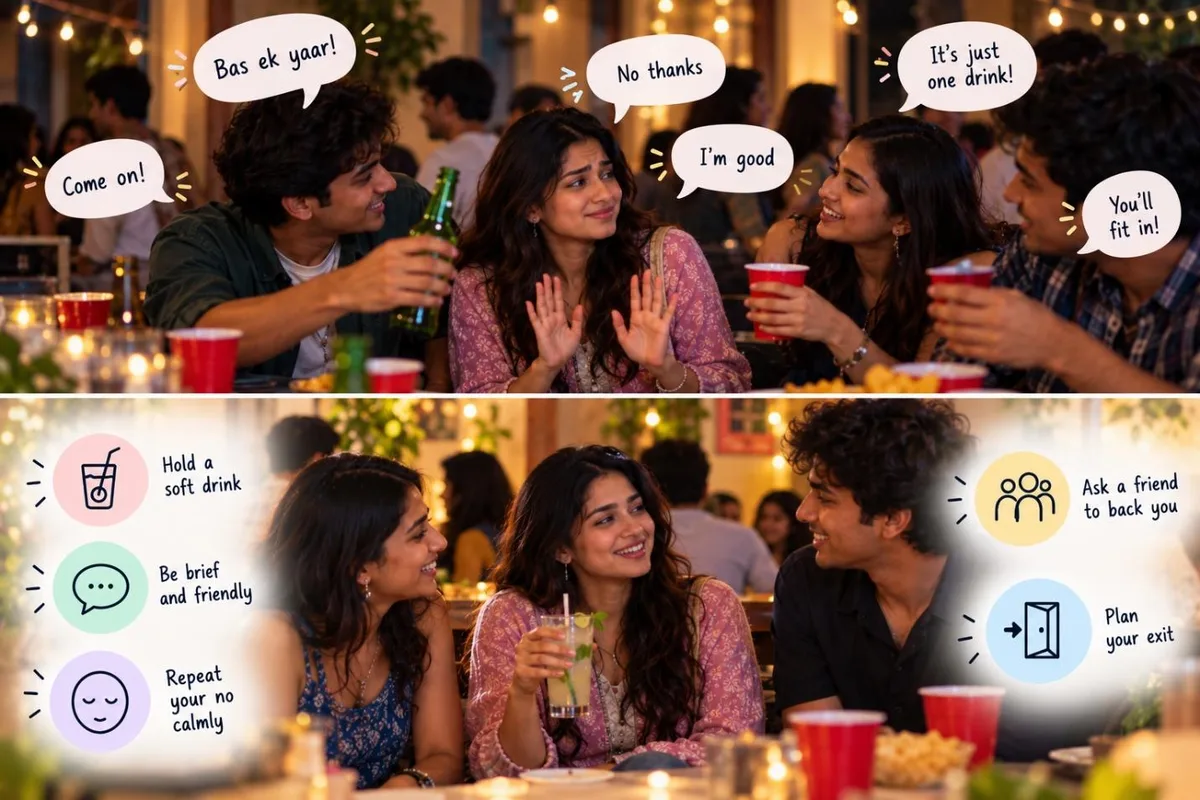
It’s your first month of college and you’re at a hostel party. Someone offers you a glass. ‘Bas ek, yaar. Don’t be such a bore.’ Everyone is looking at you, waiting for you to respond. Even though you may not want to you find it difficult to say no.
You’re far from the only person who has faced this situation. Peer pressure to drink in college is one of the most common situations students face and can easily make even the most confident of people feel like they should comply.
This blog will explain why we feel such pressure to drink, why it can be less than we think and how to say no or drink less.
What peer pressure looks like
Sometimes peer pressure can come from:
- Direct pressure – Constant offers to drink, teasing (“tu toh bachcha hai”) and ordering you drinks.
- Indirect pressure – Everyone having a drink, seeing pictures of the party on Instagram and worrying you’ll miss out on the jokes.
- Internal pressure – Worrying you’ll be seen as a bore, prude or not one of the group.
Internal and indirect pressure can often be the most difficult to spot.
Why it’s difficult to say no
1. New group of people
For many students college can be a new city, new hostel/PG and beginning new friendships. We all have a basic human need to feel part of a group and can feel like we’re putting ourselves at risk.
2. Our friends affect our risk taking
A famous experiment in 2005 saw participants play a risky driving game either alone or with their friends. Those playing with their friends took more risks and this was especially prevalent in teenagers and young adults (like those in college). This is not a weakness but simply means when we are with our friends we feel the social benefit of complying is greater.
3. We all feel more comfortable drinking
A series of studies in a US university found that students always believed their peers were more comfortable drinking heavily than them. This is known as pluralistic ignorance. Many people feel uncomfortable but assume they are the only one so everyone complies.
Your friend may be feeling the exact same as you.
4. Alcohol helps with social anxiety
Alcohol can feel like an easy way to relax and fit in with a group. However, this can cause problems in the future as you will find it even harder to socialise without a drink. You may also feel more anxious the next day.
Quick note
It is completely normal to not drink in college. Many students don’t drink due to health, religious, family, sport, academic or personal reasons.
The legal age of drinking in India varies between states. Many states have a legal age over 18 (Maharashtra for example) and some states don’t allow any alcohol. This means many students will simply be complying with the law.
How to say no without losing friends
1. Plan ahead: It will be much easier to say no if you have planned ahead. Decide to not drink or to have one drink before going to the party.
2. Be brief and friendly: You don’t need to give a long explanation. Choose a response that works for you:
“No thanks, I’m good.”
- “Not tonight, I’ve got an early class.”
- “I don’t drink but I’m definitely staying for the music.”
- “I’ll just have a coke. Have your fun!”
If they continue to pressure you, calmly repeat the same thing. This is known as the broken record technique. You remain polite and don’t argue.
3. Have a drink in your hand: Having a drink in your hand (soda with lime, mocktail or water) means less people will offer you a drink and you won’t feel like you’re in the spotlight.
4. Ask a friend : Let a friend know your plans. Having someone who will back you up will make it much easier to say no. ‘She’s not drinking.’
5. Be light-hearted: Use a light-hearted response. ‘Someone has to remember tonight.’ You aren’t judging anyone’s choice.
6. Know how you’re getting home: Know how you’re getting home and when you need to leave. If the atmosphere changes and you feel uncomfortable it is okay to leave.
7. Plan activities: Suggest something you enjoy doing. Maybe a late night chai run, cricket, gaming, trekking, college fest activities or club/society. Building friendships based on shared interests will mean you have somewhere to belong that doesn’t involve drinking.
8. Friends who care: Those who care about you may tease you but will ultimately agree to your choice. If a group is constantly teasing you, pressuring you or making you feel unsafe because you’re not drinking then this shows you something about the group.
If they are pressuring you to the point of embarrassing or forcing you this could count as ragging. Contact your college’s anti-ragging committee or the National Anti-Ragging Helpline on 1800-180-5522.
Look out for your friend
Whatever your decision, knowing the signs of alcohol poisoning can help keep your friend safe. Look out for:
- Severe vomiting and confusion.
- Very slow breathing and pale/blue skin.
- Cold, clammy skin and shaking.
- Unresponsive or not waking up.
If you notice any of these signs call 112 immediately. Put them in recovery position (on their side) so they don’t choke. Stay with them. Don’t try to make them vomit, don’t put them in a cold shower and don’t assume they will sleep it off.
When to contact a professional
If you’re struggling with:
- Feeling unable to socialise or relax without drinking.
- Social anxiety prevents you from making friends.
- Often drinking more than intended and regretting what happened the previous night.
- Feeling lonely, down or homesick most days.
- Peer pressure impacting your sleep, studies or self-esteem.
Many colleges have counseling cells. This is a great place to start. If you prefer, you can also have online therapy sessions. Talking to a counsellor about stress and anxiety can increase your confidence in social situations. Talking to a counsellor about alcohol and substance abuse can help if you’re finding drinking difficult. Read our blog ‘When Does Drinking Become a Concern?’ for more information on the signs.
If you or a friend are in crisis contact Tele-MANAS on 14416 (Free Government Mental Health Helpline) or 112 in an emergency.
Conclusion
Saying no to a drink doesn’t mean saying no to your friends, fun or college. Most of the pressure you feel is less than you think and many people will be feeling the same as you. Keeping your response brief and friendly, planning ahead and having one good friend will make all the difference.
If social anxiety, stress or drinking is causing you issues, contact one of Zenup Health psychologists for confidential online sessions. They can help you gain more confidence.
FAQs
How can I politely say no to alcohol at a party?
Use a brief and friendly response. ‘No thanks, I’m good’ or ‘I’ll just have a coke tonight’. Have a soft drink in your hand, stay involved in the conversation and calmly repeat your response.
Is it okay to not drink in college?
Yes. Many students don’t drink due to health, religious, family, sport or personal reasons. The legal age of drinking is over 18 in many states in India so it is common to not drink.
How can I deal with peer pressure in college?
Plan ahead, ask a friend who knows your plans, have a response ready and build friendships based on shared interests. If they are pressuring you to the point of bullying contact your college’s anti-ragging committee.
Will I lose friends if I don’t drink?
Good friends will respect your decision. Many people will secretly feel the same as you. If a group are constantly teasing you for not drinking it may be worth spending more time with those who share your interests.
How can I have fun at parties without drinking?
Focus on the music, dancing, food and chatting. Take on a role such as playlist picker. Plan alcohol free activities such as late night chai, gaming or treking.
Can counselling help with social anxiety & peer pressure?
Yes. Talking to a counsellor about stress and anxiety can help you feel more relaxed in social situations and set boundaries confidently.
References
- Gardner, M., & Steinberg, L. (2005). Peer influence on risk taking, risk preference, and risky decision making in adolescence and adulthood: An experimental study. Developmental Psychology, 41(4), 625–635. https://doi.org/10.1037/0012-1649.41.4.625
- Prentice, D. A., & Miller, D. T. (1993). Pluralistic ignorance and alcohol use on campus: Some consequences of misperceiving the social norm. Journal of Personality and Social Psychology, 64(2), 243–256. https://doi.org/10.1037/0022-3514.64.2.243
- Health Service Executive (Ireland). (n.d.). Alcohol poisoning. https://www2.hse.ie/living-well/alcohol/health/how-alcohol-can-affect-everyday-life/alcohol-poisoning/
- National Ragging Prevention Programme (UGC). National Anti-Ragging Helpline, 1800-180-5522. https://www.antiragging.in
- Ministry of Health and Family Welfare, Government of India. Tele-MANAS. https://telemanas.mohfw.gov.in
