 Skip to content
How to Talk to Your Parents About Wanting to See a Psychiatrist
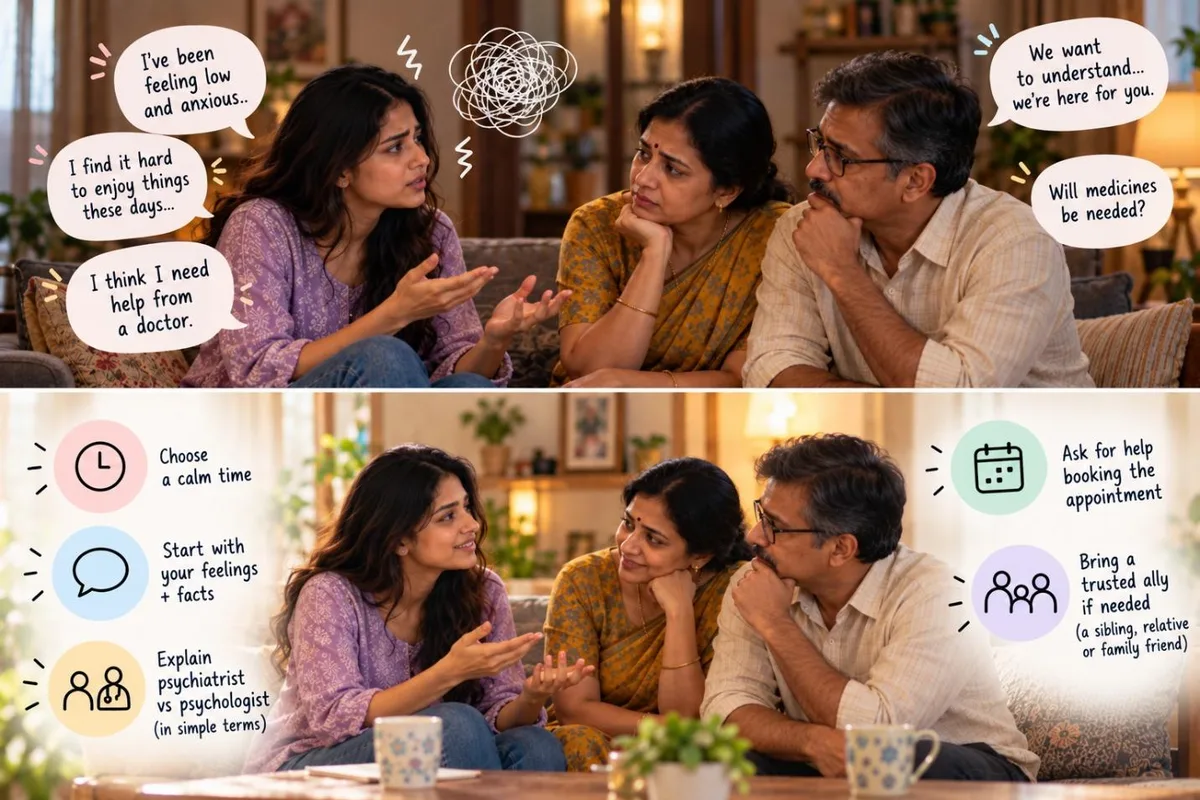
You’ve rehearsed it in your head a dozen times. “Mumma, Papa, I think I need to see a psychiatrist.” And every version ends the same way: “Psychiatrist? Why? You’re not mad. What will people say?”
So you keep putting it off, even though the sleepless nights, the heaviness or the panic aren’t going away.
If you’re trying to work out how to tell your parents you want to see a psychiatrist, the fact that you’re planning this conversation already shows courage and self-awareness.In this blog, we cover why this conversation feels so hard, when to consult psychiatrist, how to prepare, what to say, and what to do if it doesn’t go well the first time.
Why this conversation feels so hard
Mental health still carries stigma in many Indian families. India’s National Mental Health Survey (2015–16) named stigma, low awareness and cultural beliefs among the main barriers to care. It found that most people with common conditions like stress and anxiety had not received treatment.
For many parents, the word “psychiatrist” brings up old, frightening images. They may worry about what relatives will think, how it might affect your future or marriage prospects, or whether they did something wrong as parents.
You might be carrying worries too: that you’ll be dismissed, lectured or told you’re “just stressed.” A review of research on young people found that stigma, embarrassment, difficulty recognising symptoms and wanting to handle things alone were some of the biggest barriers to seeking help. It also found that encouragement from people around you makes help-seeking easier, which is exactly why this conversation matters.
Psychiatrist vs psychologist: what’s the difference?
It helps to be clear on this before you talk, because your parents may ask.
- A psychiatrist is a medical doctor (MBBS followed by specialist training in psychiatry). They can assess your symptoms, rule out physical causes, make a diagnosis and prescribe medicines if needed.
- A psychologist is trained in talk therapy and helps you understand and change thought patterns, emotions and behaviour. Psychologists don’t prescribe medicines.
The two often work together. Seeing a psychiatrist doesn’t automatically mean you’ll be put on medicines. Many people start with an assessment and a plan that may include therapy, lifestyle changes, medicines or a mix.
Want a deeper comparison? Read our blog on psychiatrist vs psychologist vs counsellor.
When to consult a psychiatrist
It may be time to see a psychiatrist if, for more than two weeks:
- You feel low, anxious, empty or irritable most days
- Your sleep or appetite has changed a lot
- You’re struggling to study, work or get through the day
- You’re having panic attacks, or worries you can’t switch off
- Therapy or self-care alone hasn’t been enough
If you’re having thoughts of harming yourself, don’t wait to plan the perfect conversation. Reach out right away (see the end of this blog).
Before the conversation
- Be clear about what you’re asking for: Do you want permission, help booking an appointment, help paying, or someone to come with you? Knowing your ask makes the conversation easier for everyone.
- Write down what you’ve noticed: Parents often respond better to specific examples than to general statements. Note a few things: “I’ve been sleeping three to four hours most nights for a month.” “I’ve had panic attacks before exams.” “I don’t enjoy things I used to love.”
- Choose the right person, time and place: Pick a calm moment, not right after an argument or during a busy morning. If one parent is likely to be more understanding, start with them. A trusted aunt, cousin, elder sibling or your family doctor can also be a helpful ally.
- Do a little homework: Have basic details ready: who you’d like to see, the approximate cost, and how an online consultation works. Practical information makes the idea feel less scary and more real.
During the conversation
1. Start with feelings and facts
Try something like:
“I need to talk to you about something important. For the last few weeks I haven’t been feeling like myself. I’m not sleeping properly, I feel low most days, and it’s affecting my studies. I’ve tried to handle it on my own, but I think I need help from a doctor.”
2. Use language that feels familiar: Some parents relate more easily to “doctor” and “health” than to “mental illness.” You might say, “If I had a fever for weeks, you’d take me to a doctor. This is similar. My mind and body need help.”
3. Ask for support, not just permission: “I’m not asking you to fix this. I just want you to support me in seeing someone who can.”
4. Expect emotion, and give them time: Your parents may react with worry, guilt or even anger. That’s often fear speaking. You don’t need to win the conversation in one go. Saying “Please think about it, and we can talk again tomorrow” is fine.
Common reactions and how to respond
| What they might say | What you could say |
|---|---|
| “It’s just stress. It will pass.” | “I hoped so too, but it’s been weeks and it’s getting harder. A doctor can tell us if it’s something more.” |
| “What will people say?” | “Consultations are confidential. No one needs to know unless we choose to tell them.” |
| “They’ll put you on medicines and you’ll get addicted.” | “Not everyone needs medicines. If the doctor suggests any, they’ll explain how they work and their side effects, and we can decide together.” |
| “Did we do something wrong?” | “This isn’t about blame. I’m telling you because I trust you and want your support.” |
| “Just pray, meditate or exercise more.” | “Those things can help, and I’ll keep doing them. I’d also like a doctor’s advice alongside them.” |
If they say no
A first “no” isn’t always the final answer. Many parents need time to process.
- Give it a few days, then bring it up again calmly.
- Share information. A short article, like this one, can answer questions they might not ask out loud.
- Bring in a trusted adult, such as your family doctor, a relative or a college counsellor, who can speak to your parents.
- If you’re 18 or older, you can book a psychiatrist online consultation yourself. Many young adults start on their own and involve family later.
- If you’re under 18, a parent or guardian usually needs to be involved in treatment. In the meantime, speak to a school or college counsellor, or call Tele-MANAS on 14416 for free support and guidance.
When not to wait
If you’re having thoughts of ending your life or harming yourself, can’t eat or sleep for days, or feel unsafe, please tell any trusted adult right away. In India, you can call Tele-MANAS on 14416, a free government mental health helpline, or 112 in an emergency.
Conclusion
Asking for help is a sign of strength, and telling your parents is a brave step. Go in prepared with specific examples, a clear ask and a little patience. Even if the first conversation is hard, it opens the door to support, for you and often for your family too.
When you’re ready, Zenup Health offers confidential psychiatrist online consultations from home, whether you’re looking for an online psychiatrist in Mumbai or anywhere in India. Some families find it helps for a parent to join part of the first consultation, and you can ask about this when you book.
FAQs
How do I tell my parents I want to see a psychiatrist?
Pick a calm time, start with how you’ve been feeling and give specific examples, then make a clear request: “I’d like your support in seeing a doctor.” Expect questions, and give them time to think.
What if my parents don’t believe in mental health?
Use familiar language, such as health, sleep or concentration, and compare it to seeing a doctor for a physical problem. A trusted adult or your family doctor can also help explain.
When should I consult a psychiatrist?
If low mood, anxiety, sleep or appetite changes, or difficulty functioning last for more than two weeks, or if therapy alone isn’t helping, a psychiatrist can assess what’s going on. Seek help immediately if you have thoughts of self-harm.
What is the difference between a psychiatrist and a psychologist?
A psychiatrist is a medical doctor who can diagnose conditions and prescribe medicines. A psychologist provides talk therapy and doesn’t prescribe. They often work together.
Can I see a psychiatrist without my parents knowing?
If you’re 18 or older, yes. You can book a confidential online psychiatrist consultation yourself. If you’re under 18, a parent or guardian usually needs to be involved, but a school counsellor or Tele-MANAS (14416) can support you meanwhile.
Will seeing a psychiatrist mean I have to take medicines?
Not necessarily. A psychiatrist will assess you and discuss options, which may include therapy, lifestyle changes, medicines or a combination. Any medicine is explained and decided on together.
References
- Gulliver, A., Griffiths, K. M., & Christensen, H. (2010). Perceived barriers and facilitators to mental health help-seeking in young people: A systematic review. BMC Psychiatry, 10, 113. https://doi.org/10.1186/1471-244X-10-113
- Gururaj, G., Varghese, M., Benegal, V., et al. (2016). National Mental Health Survey of India, 2015–16: Summary. National Institute of Mental Health and Neuro Sciences (NIMHANS), Bengaluru. https://mohfw.gov.in/sites/default/files/National%20Mental%20Health%20Survey%2C%202015-16%20-%20Summary%20Report_0.pdf
- Ministry of Health and Family Welfare, Government of India. Tele-MANAS. https://telemanas.mohfw.gov.in
