 Skip to content
How to Talk About Your Feelings Without Fighting
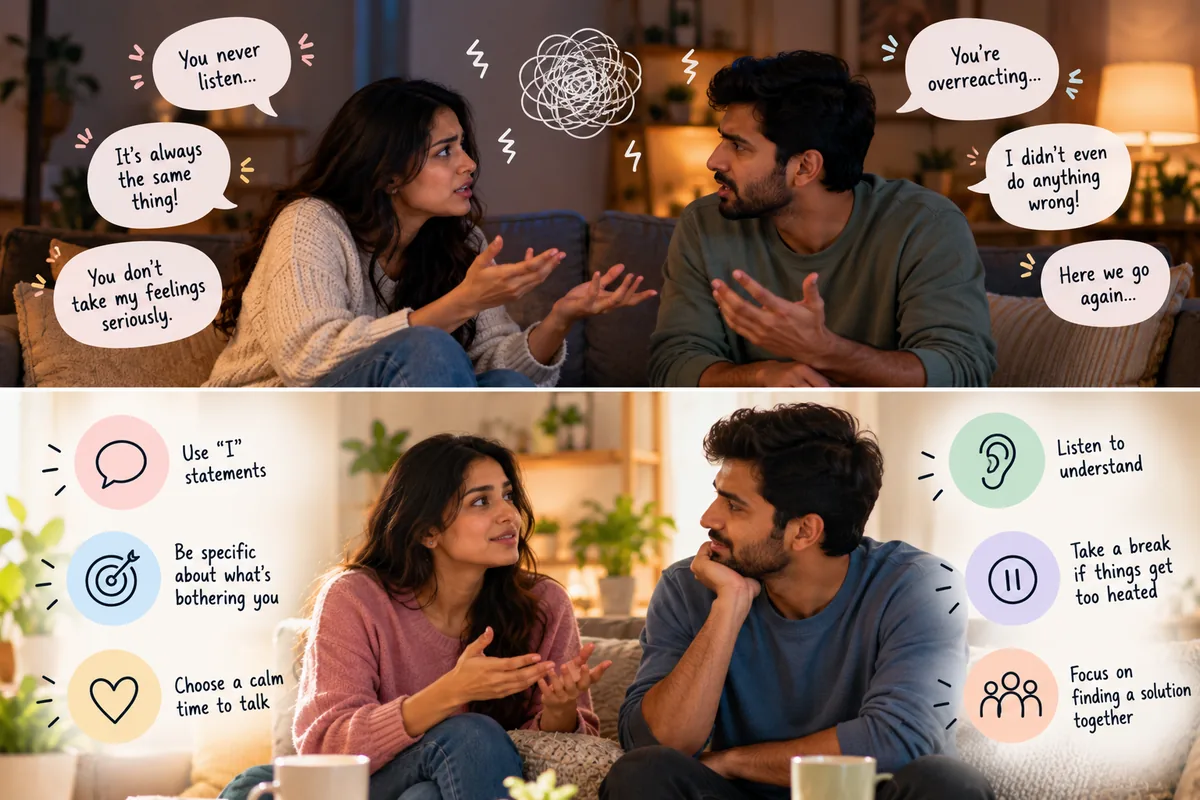
It is 10 pm. You have been holding something in all day: your partner forgot, again, to call your parents back, and your mother has messaged you twice asking if everything is okay. You finally say it. “You never take my family seriously.” Within two minutes you are both talking over each other, old issues from last Diwali are back on the table, and the thing you actually felt, which was hurt and a little embarrassed, has disappeared under the noise.
If that sounds familiar, you are not bad at relationships. Most of us were never taught how to talk about our feelings without fighting. We learnt to either swallow things or let them out in a burst. The good news is that expressing feelings in a relationship is a skill, and skills can be practised, even with the help of relationship counselling.
This guide focuses on couples, but the same ideas work with parents, siblings, flatmates and friends.
Why talking about feelings so often turns into an argument
The first few sentences set the tone
Relationship researcher John Gottman and his colleagues have spent decades observing couples during disagreements. One of their consistent findings is that the way a conversation begins strongly shapes how it ends. In one study of 124 newlywed couples followed over six years, the first three minutes of a conflict discussion predicted which couples later divorced. Couples who split up tended to open with more negativity and criticism, and less warmth.
Gottman calls a blaming or attacking opening a harsh start-up. Its opposite, a softened start-up, raises the same concern but without blame. The issue is not whether you bring up the problem. It is how.
Criticism sounds like an attack on who someone is
There is a difference between a complaint and a criticism. A complaint is about a specific situation: “The bill was due yesterday and it didn’t get paid.” A criticism is about the person’s character: “You’re so irresponsible.”
When people hear criticism, they usually defend themselves, the defence sounds like dismissal, and both sides escalate.
Your body can hijack the conversation
Sometimes an argument goes off track because one or both people become emotionally flooded. Flooding is a term Gottman uses for the state in which your body goes into high alert during conflict: your heart races, you feel hot or shaky, and it becomes very hard to listen or think clearly. In that state, even a kind sentence can sound like an attack, and most of us say things we later regret.
How it shows up in everyday life
You might recognise some of these patterns:
Using “always” and “never” (“You never help with dinner”).
Bringing up a list of old complaints along with today’s issue.
Raising something important when one of you is tired, hungry or about to leave for work.
Going silent, scrolling on your phone or walking away mid-sentence because it feels too much.
Saying “I’m fine” and then being cold for the rest of the evening.
These are common, understandable ways of protecting ourselves when we feel hurt. They just tend to make the other person protect themselves too.
Practical ways to express your feelings without starting a fight
1. Pick your moment
A conversation started while someone is rushing out the door or replying to office emails is unlikely to go well. Try asking first: “Something’s been on my mind. Is now a good time, or can we talk after dinner?”
2. Use a softened start-up
A softened start-up usually has three parts:
How you feel (“I feel…”)
About what specific situation (“…when…”)
What you need or would like (“Could we…?”)
Harsh: “You never take my family seriously.”
Softer: “I felt embarrassed when Mummy messaged twice and we hadn’t called back. Could we decide together who will call her this weekend?”
The second version still raises the issue, but leaves room to respond instead of defend.
3. Make your “I” statements genuine
“I” statements keep the focus on your experience rather than on the other person’s faults. Research supports this: in a 2018 study, university students rated “I” statements as less likely to make someone defensive than “you” statements. Statements that also acknowledged the other person’s point of view were rated least likely of all to trigger defensiveness.
One caution: putting “I feel” in front of an accusation does not make it an “I” statement. “I feel like you’re selfish” is still a criticism. Try naming an actual emotion instead: hurt, worried, lonely, overwhelmed, left out.
4. Describe, don’t judge
Stick to what happened, the way a camera would record it. “You came home at 11 and didn’t message” is a description. “You don’t care about me” is a judgement, and it invites an argument about whether it is true.
5. One issue at a time
When we finally speak up, it is tempting to empty out the whole cupboard, but a list of ten grievances feels overwhelming. Choose the one thing that matters most today. Raising small issues as they come up, rather than storing them, also helps.
6. Acknowledge their side, too
You do not have to agree with someone to show that you understand them. Simple lines like “I know you’ve had a very long week” or “I can see why you thought I’d handle it” lower the temperature and match what the research above found most helpful.
7. Take a break when you’re flooded, and come back
If you notice your heart pounding, your voice rising or your mind going blank, pause. Say something like: “I want to sort this out, but I’m too worked up right now. Can we take 20 minutes and come back to it?”
The Gottman Institute suggests a break of at least 20 minutes, because the body needs time to settle. During the break, try not to rehearse your arguments in your head. Walk, listen to music or breathe slowly. The key is to actually return. A break with a clear “let’s come back at 9” is very different from storming out or going silent for days.
A small exercise to try this week
Think of one minor recurring irritation, such as wet towels on the bed or late replies to messages. Write down a softened start-up for it using “I feel… when… could we…?” Use it the next time the situation comes up, while you are both calm. Practising on small issues makes bigger ones easier.
When it’s family or friends
The same approach works outside romantic relationships. With parents, it can help to open with respect (“I know you’re asking because you care…”) before sharing your feeling. With friends, naming the friendship’s value first (“Our friendship matters to me, which is why I want to bring this up”) can make honesty feel safer for both of you.
When communication tips are not enough
If there is fear, threats, control or violence
These tips are for relationships where both people feel safe, even when they disagree. If you are afraid of your partner or a family member, if they threaten you, check or restrict your phone, money or movements, isolate you from others, or hurt you physically or sexually, that is not a communication problem. It is abuse, and better wording on your side will not fix it.
In that situation, your safety comes first. Reach out to someone you trust, and if you are in immediate danger, call 112, India’s emergency number. You can also call Tele-MANAS on 14416, the Government of India’s free mental health helpline, for support and guidance.
When to consider professional support
It may help to speak with a professional if:
The same arguments repeat without ever getting resolved.
One or both of you shuts down or avoids difficult topics altogether.
Conflict is affecting your sleep, work, health or how you feel about yourself.
There has been a breach of trust, such as an affair or a big financial secret.
Relationship counselling or marriage counselling offers a structured, neutral space where a trained psychologist helps both of you understand your patterns and practise new ways of talking. Many couples now choose online couples therapy because it fits around work schedules and family responsibilities. If your partner isn’t ready to join, individual therapy can still help you understand your own reactions and communicate more calmly.
Conclusion
Talking about your feelings without fighting does not mean never disagreeing. It means raising issues in a way that invites your partner, parent or friend to stay in the conversation with you. Start gently, speak about your own experience, stick to one specific issue, acknowledge the other person’s view, and take a proper break when emotions run too high. It will feel unnatural at first, and slipping up is part of learning.
If you would like support with this, Zenup Health’s psychologists offer online sessions, both individual and couples counselling online, so you can work on these conversations at your own pace, from wherever you are.
FAQs
How do I talk about my feelings without fighting with my partner?
Choose a calm moment, start gently and describe one specific situation rather than your partner’s character. A simple structure is “I feel… when… could we…?” If either of you becomes too upset to think clearly, agree on a break and come back to it.
How do I express my feelings in a relationship without sounding like I’m blaming?
Name a real emotion (hurt, worried, lonely) and link it to a specific event. Avoid “always”, “never” and “I feel like you’re…”, which usually turn into criticism. Acknowledging your partner’s point of view as well can make them less defensive.
What should I do if my partner shuts down or walks away during an argument?
They may be emotionally flooded, which means overwhelmed to the point of not being able to listen. Instead of pushing, suggest a break of at least 20 minutes and agree on a time to return. If shutting down happens often, couples counselling can help you both understand the pattern.
Do these tips work with parents and friends too?
Yes. Gentle openings, “I” statements and one issue at a time work in most close relationships. With parents, starting with respect for their intentions often helps them hear you.
When should we consider couples counselling online?
Consider it if the same arguments keep repeating, one of you avoids difficult topics, or conflict is affecting your health or work. Online couples therapy lets you meet a psychologist from home. If there is fear, threats, control or violence, prioritise safety and support first.
References
Carrère, S., & Gottman, J. M. (1999). Predicting divorce among newlyweds from the first three minutes of a marital conflict discussion. Family Process, 38(3), 293–301. Summary: https://www.gottman.com/blog/the-research-predicting-divorce-among-newlyweds-from-the-first-three-minutes-of-a-marital-conflict-discussion/ ; University of Washington news release: https://washington.edu/news/1999/09/27/first-three-minutes-of-discussion-about-on-going-area-of-marital-conflict-are-predictive-of-divorce-for-newlyweds
Rogers, S. L., Howieson, J., & Neame, C. (2018). I understand you feel that way, but I feel this way: The benefits of I-language and communicating perspective during conflict. PeerJ, 6, e4831. https://doi.org/10.7717/peerj.4831
Wilde, E. (2013, March 15). Softening start-up. The Gottman Institute. https://www.gottman.com/blog/softening-startup/
Wilde, E. (2013, March 1). Weekend homework assignment: Physiological self-soothing. The Gottman Institute. https://www.gottman.com/blog/weekend-homework-assignment-physiological-self-soothing/
World Health Organization. (2026). Violence against women [Fact sheet]. https://www.who.int/news-room/fact-sheets/detail/violence-against-women
Ministry of Health and Family Welfare, Government of India. (n.d.). Tele-MANAS. https://telemanas.mohfw.gov.in/
